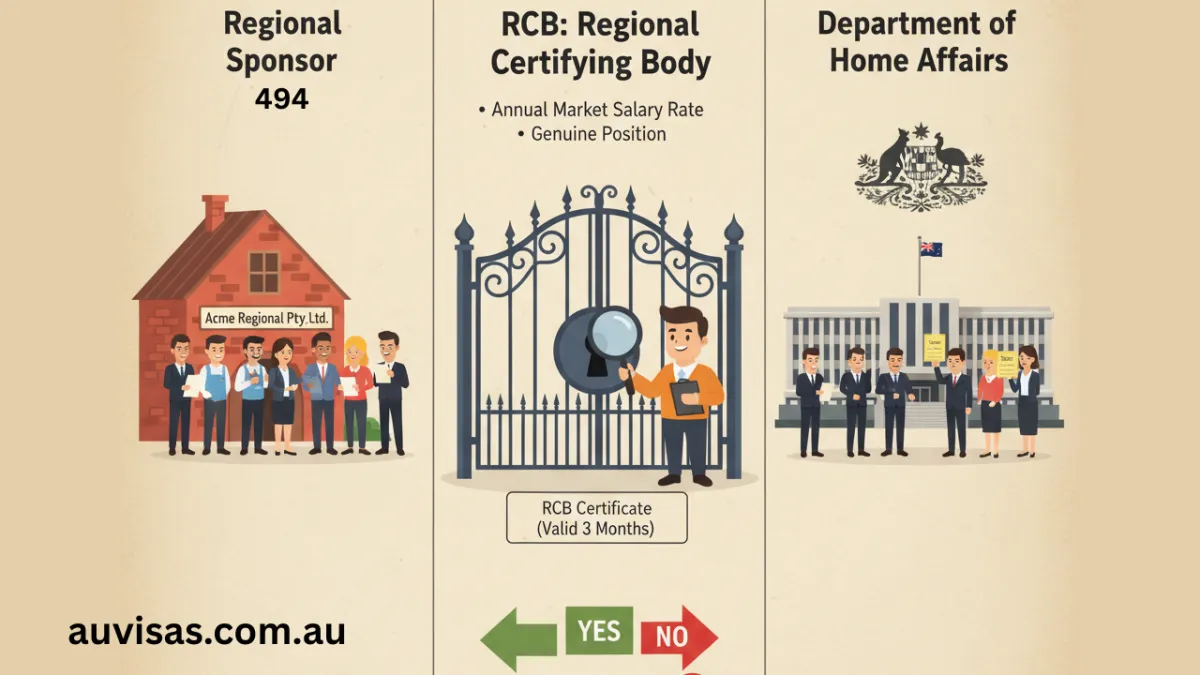
Employer Guide: The Regional Certifying Body (RCB) - The Hidden Compliance Gatekeeper in Regional Skilled Migration
Why the RCB Is the Step That Can Make or Break Your 494 Nomination
If you’re a regional employer looking to sponsor skilled staff under the Skilled Employer Sponsored Regional (Subclass 494) visa, you’ll need to pass through one mandatory checkpoint before your nomination even reaches the Department of Home Affairs: the Regional Certifying Body (RCB).
Many employers treat the RCB as a mere formality. In reality, it’s one of the most powerful and misunderstood compliance steps in the skilled-migration process. Get it wrong, and your nomination can stall or collapse entirely.
This guide demystifies the RCB, explains its legal scope, outlines who you’ll work with, and highlights the strategic traps most regional businesses never see coming.
What Is the RCB (Regional Certifying Body)?
The Regional Certifying Body is a locally appointed organisation - usually your regional RDA (Regional Development Australia) office - that provides independent advice to Home Affairs about two statutory matters for every 494 nomination:
Annual Market Salary Rate (AMSR):
Does the nominated worker’s salary and employment conditions meet or exceed what an Australian in the same region would reasonably earn?Genuine Need for the Position:
Is the role genuine and ongoing, taking into account local labour-market demand and business activity?
The RCB doesn’t decide the visa - but its recommendation carries real weight. A negative RCB assessment almost always results in nomination refusal.

👉 Tip: You can technically lodge the nomination before receiving RCB advice, but Home Affairs won’t decide it until the positive RCB letter is attached—and RCB assessments are valid for only three months from issue.

Each RCB sets its own application form, fee ($700 – $1,200 per role), and documentation list.
What the RCB Assesses (And What It Does Not)
Focus Areas:
AMSR Evidence: Provide Fair Work Awards, enterprise agreements, market salary surveys, or Australian staff payslips to justify pay level.
Position Genuineness: Show the role is ongoing - supply organisational charts, revenue trends, and proof of regional operations.
Business Legitimacy: ABN, BAS statements, recent financials, and lease or property ownership.
LMT Summary: Brief evidence that advertising occurred (but remember - Home Affairs is the true LMT enforcer).
Not Their Focus:
Worker’s skills assessment or qualifications (Home Affairs handles that).
Sponsor obligations checks (such as training or past compliance).
The RCB looks through a local lens: “Would a genuine regional employer pay and hire like this?”
Processing Times and Validity

Best Practice: Don’t apply to the RCB until your LMT and nomination paperwork are ready. Lodge the nomination within days of receiving RCB approval to avoid expiry.
Who Communicates with the RCB

RCB officers are usually approachable local staff with strong knowledge of their region’s labour market. A professional, transparent relationship with your RCB can smooth the process considerably.
RCB vs DAMA - Strategic Alternatives

Strategic Insight: If your role or candidate can’t meet the TSMIT or isn’t on the Skilled List, a DAMA pathway is often faster and more flexible than a standard 494 RCB route.
Common Employer Mistakes (And How to Avoid Them)
Relying on the TSMIT as proof of AMSR.
The RCB wants real market evidence for your region - not just the national minimum.Submitting inconsistent documents.
Job ads, contracts, and Form 1404 must align exactly. Discrepancies = red flags.Applying too early.
RCB approvals expire after 3 months; timing is everything.Ignoring regional context.
Show commitment to your local area - photos of operations, local partnerships, and community involvement can help demonstrate genuine need.
The Wider Value of the RCB
Beyond compliance, RCBs serve a strategic purpose: they feed data to Home Affairs about regional skill shortages. Your RCB submission helps shape future occupation lists and DAMA agreements. By engaging with the RCB professionally, you not only secure your nomination — you help build your region’s long-term migration capacity.
Final Thought
The Regional Certifying Body isn’t bureaucracy for bureaucracy’s sake. It’s the local audit that protects the credibility of regional migration and ensures employers do the right thing by both Australian workers and their sponsored staff.
Handled well, it becomes a badge of trust - evidence that your business is a compliant, ethical, and long-term regional employer.
Action Required
If you’re a regional employer planning a 494 sponsorship or evaluating whether a DAMA pathway is more strategic, AU Visas can:
✅ Conduct a pre-assessment of your Annual Market Salary Rate (AMSR) against your RCB’s benchmarks.
✅ Prepare and audit your RCB submission package.
✅ Coordinate timing so RCB approval and nomination align perfectly.
✅ Advise whether the DAMA stream offers a better fit for your roles.
Related Articles that you may enjoy
Source: AU Visas Employer Guide Series
Disclaimer
The content provided is here is for informational purposes only and does not constitute immigration or legal advice. It is subject to change. Consult an Australian MARA registered agent or lawyer for professional advice before making any application
👉Contact AU Visas today for a Professional Opinion on Your Situation.
Glossary of Key Terms
Regional Certifying Body (RCB) A local organisation, typically a Regional Development Australia (RDA) office or state authority, that provides advice to the Department of Home Affairs on 494 nominations. It assesses whether the salary meets the Annual Market Salary Rate and whether the position is genuine and needed in the region.
494 Visa – Skilled Employer Sponsored Regional (SESR) A provisional employer-sponsored visa that allows skilled workers to live and work in designated regional areas. It requires RCB advice for nominations and commonly leads to permanent residency via the 191 visa.
Annual Market Salary Rate (AMSR) The typical salary an Australian worker would earn for the same role in the same location. Employers must demonstrate that the nominated salary meets or exceeds the AMSR to avoid undercutting local wages.
TSMIT – Temporary Skilled Migration Income Threshold The national minimum income threshold that most sponsored workers must meet. While important, TSMIT alone does not prove that a salary reflects the AMSR for a specific region and occupation.
Labour Market Testing (LMT) The requirement to advertise a role in specific ways and for a minimum period to show that no suitably qualified Australian workers are available. LMT is assessed primarily by Home Affairs, with RCBs often reviewing it as context.
Regional Development Australia (RDA) A network of regional bodies that promote economic development and often act as the RCB for skilled migration in their area. Examples include RDA Orana and RDA Riverina.
Nomination (for 494) The application lodged by the employer to Home Affairs specifying the role, salary, location and nominated worker. For the 494 visa, a valid positive RCB assessment must accompany or be linked to the nomination.
Form 1404 – Regional Certifying Body Advice The standard form used for RCB advice under some programs. It records the RCB’s assessment of the salary and genuineness of the position. Some RCBs use their own online equivalents.
Designated Regional Area Areas classified by the Australian Government as “regional” for migration purposes. Only businesses operating in these areas can sponsor workers under the 494 visa.
DAMA – Designated Area Migration Agreement A type of Labour Agreement that allows designated regions to sponsor workers in additional occupations and with concessions to standard rules. Under a DAMA, a Designated Area Representative (DAR) endorses roles and employers instead of using an RCB.
DAR – Designated Area Representative The body responsible for managing a DAMA in a specific region. The DAR endorses employers and positions under the agreement and interacts with Home Affairs on Labour Agreement matters.
Skilled Occupation List A list of occupations eligible for specific skilled visa programs. For standard 494 nominations, the occupation must usually appear on the relevant skilled list, unless a Labour Agreement such as a DAMA provides additional options.
Genuine Position A requirement that the nominated role reflects a real, ongoing need in the business, aligned with the nominated occupation and supported by business activity and regional labour-market conditions.
Sponsor Obligations Legal duties imposed on approved sponsors, including paying correct wages, keeping records, notifying Home Affairs of key changes and ensuring the worker performs the nominated occupation in the approved location.


