How Much Does Sponsoring a Worker Really Cost?
(Full Breakdown for Regional Employers)
For Regional NSW Businesses Using 482, 494, DAMA & Labour Agreements
Bringing a skilled worker from overseas into a regional business feels like a huge undertaking - especially when the true cost is unclear. Most employers only hear fragments:
“Visas are expensive.”
“SAF levy is huge.”
“You need a migration agent.”
“It takes months.”
But when we break down the process properly, sponsorship is far more manageable and affordable than most regional employers expect.
And importantly - the cost is often far lower than the cost of chronic shortages, downtime, or high staff turnover.
(If you want to view a previous Blog post on how the process costs $18/day to employ your first sponsored team-member, click here - https://auvisas.au/post/costperday )
This indicative guide gives you an transparent, and legally compliant breakdown of the real employer costs, including the mandatory fees, the optional extras, and the often-forgotten-but-essential overseas recruitment expenses. Always consult a Registered Migration Agent about your specific situation though.
Our aim: to help regional employers plan confidently and make informed decisions.
✅ 1. The Three Financial Stages of Sponsorship
Every employer-sponsored visa pathway - 482 TSS, 494 SESR, DAMA, HILA, or other Labour Agreements - breaks down into three cost phases:
Becoming an Approved Sponsor
Nominating the Position and the Worker
Worker’s Visa Application (their cost, your choice to assist)
Each stage has different obligations and financial commitments.
✅ 2. Phase One: Becoming an Approved Sponsor (SBS or Labour Agreement)
If you’ve never sponsored before, you must apply for:
Standard Business Sponsorship (SBS) or
a Labour Agreement (DAMA, HILA, Industry Agreement)
These approvals allow you to legally sponsor workers for up to 5 years.

Timeframes
SBS: 2–8 weeks
Labour Agreement: 3–6 months +
Employer Insight
Getting approved is usually the smallest fee, but proving the genuineness of the role and the capacity to meet your obligations is where most employers struggle.
Once approved, you can sponsor multiple workers over 5 years - a strategic advantage for future hiring.
✅ 3. Phase Two: Nomination Costs (The Major Employer Investment)
The Nomination application proves:
the role is genuine
the salary meets market rates (AMSR)
you could not find an Australian worker (LMT)
the worker has the required skills and experience
This stage contains the largest mandatory employer fees.

Employer Insight
This is the stage where most employers underestimate costs - because SAF is large, upfront, and cannot be passed on to the worker under any circumstance.
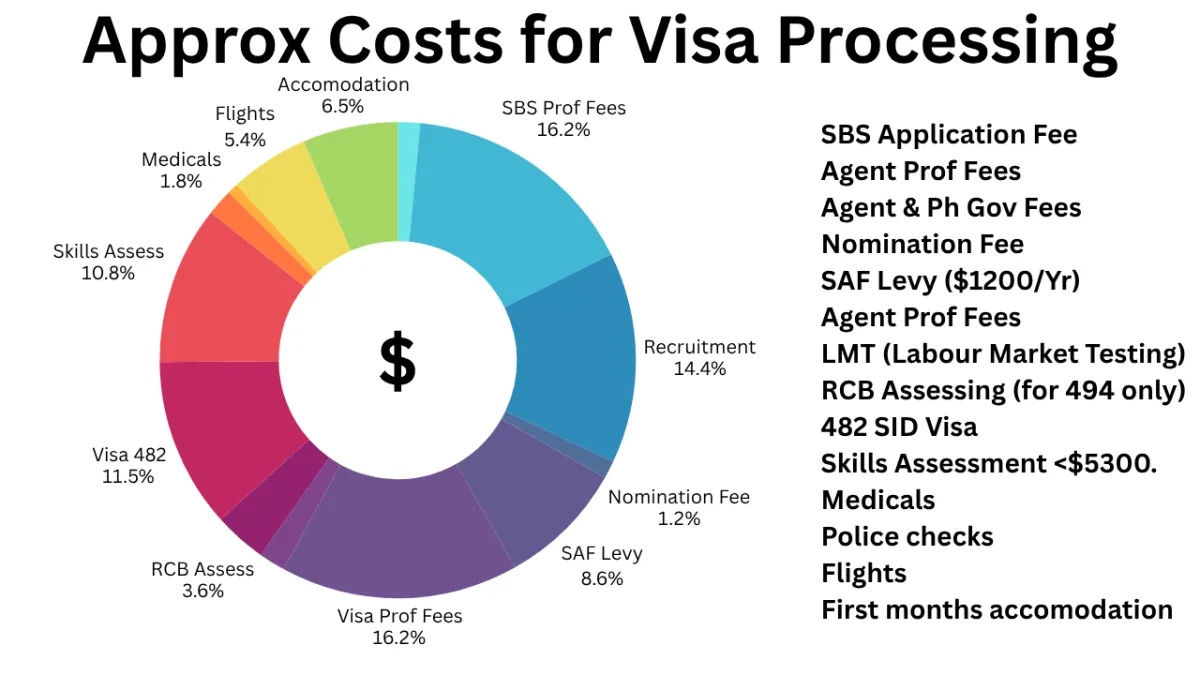
✅ 4. Essential Overseas Recruitment Costs (Frequently Overlooked)
If your worker is coming from overseas, especially from the Philippines, you must factor in regulated recruitment and government clearance costs.
These are not visa fees but are mandatory processing and compliance costs in the worker’s home country.

Why This Matters
The Philippines has strict legal requirements:
all overseas employment must go through a DMW/POEA-licensed agency
workers cannot exit the country without OEC clearance
This ensures:
your worker is verified, compliant, and legally deployed
you as the employer are protected from illegal recruitment risks
the worker receives mandatory pre-departure support
Employer Insight
Always budget this in.
It is part of the real cost of bringing someone to Australia - especially from the Philippines.
✅ 5. Phase Three: The Worker’s Visa Costs (Your Choice to Assist)
Legally, these are the worker’s costs, unless you choose to assist commercially.

Optional employer-paid contributions
Many regional employers choose to assist with:
flights ($1,200–$2,500)
first month of accommodation
visa fees
skills assessment fees
This is optional - but boosts attraction and retention.
Legal Reminder
You must NEVER recoup:
SAF levy
nomination fee
SBS fee
recruitment clearances
migration agent fees
from the worker.
✅ 6. Realistic Cost Scenarios (Including Professional Support)
To provide a real-world picture, these scenarios include professional migration agent support, because most first-time employers use it to ensure compliance.

✅ 7. The Hidden Obligations (Do NOT Forget These)
Beyond costs, sponsorship carries ongoing obligations:
Mandatory Employer Obligations
Pay the AMSR (Annual Market Salary Rate)
Must match what an Australian worker would earn locally.Keep impeccable records
Payslips, contracts, hours, training, RCB/LMT documents.Notify Home Affairs of:
role changes
pay changes
reduced hours
worker ceasing employment
business insolvency
No role changes without a new nomination
Even a “promotion” may require a new nomination.Mandatory repatriation costs
If the worker requests return travel home in specific circumstances.
Employer Insight
A single breach - even a small one - can result in sanctions or cancellation of your entire sponsorship approval.
✅ 8. Why Regional Employers Say Sponsorship Is Worth It
For many regional employers, the real question becomes:
What is the cost of NOT sponsoring? (See also https://auvisas.au/post/costperday )
Regional employers consistently report:
higher reliability and work ethic
far longer retention (3–6 years vs 8–14 months locally)
lower turnover costs
stability for projects, farms, and workshops
meaningful community impact
stability for the worker’s family = stability for the business
When you consider the cost of:
losing staff mid-season
repeatedly retraining new hires
downtime on machinery
delayed production
loss of contracts
…sponsorship often becomes the most cost-effective option available.
✅ 9. Practical Advice to Keep Sponsorship Affordable
Plan the AMSR early
Prevent costly nomination delays.Choose the right visa for your model
482 = fast hire.
494 = strongest retention (PR after 3 years).
DAMA/HILA = flexibility.Do LMT properly the first time
Non-compliant advertising is the single biggest avoidable refusal.Budget the SAF levy
Treat it as an insurance-style annual cost.Use sponsorship strategically
Once you sponsor one worker, map out who the next two should be to build a stable team.
✅ Final Thought: Sponsorship Is a tax-deductible Investment, Not an Expense
When broken down properly, the end-to-end cost of sponsoring a skilled worker is clear, predictable, and manageable.
For regional employers—where labour shortages are often the biggest constraint on growth -sponsorship is one of the most effective ways to secure a long-term, stable, and skilled workforce.
You don’t just get a worker.
You get consistency.
You get loyalty.
You get growth.
And you get the ability to plan your business with confidence.
Related Articles that you may enjoy
Source: AU Visas Employer Guide Series
The content provided is here is for informational purposes only and does not constitute immigration or legal advice. It is subject to change. Consult an Australian MARA registered agent or lawyer for professional advice before making any application
👉Contact AU Visas today for a Professional Opinion on Your Situation.
Glossary of Key Terms
Standard Business Sponsorship (SBS)
Approval granted by the Department of Home Affairs that allows an Australian business to sponsor overseas workers on certain employer-sponsored visas, usually for a period of up to five years.Labour Agreement
A negotiated arrangement between an employer, industry or region and the Australian Government that allows access to additional occupations and concessions outside the standard skilled visa framework. Includes company-specific agreements, DAMAs and some industry schemes such as HILA.DAMA (Designated Area Migration Agreement)
A type of Labour Agreement between the Australian Government and a regional area. It allows local employers to sponsor overseas workers for a wider range of occupations and may include concessions to age, English and salary requirements.HILA / Industry Labour Agreement
An industry-focused Labour Agreement (for example in horticulture, meat or hospitality) that sets standard terms for employers in that sector to sponsor workers where there are chronic skill shortages.Nomination
The application stage where the employer asks the Department to approve a specific position and a specific worker. It covers the occupation, salary, location, labour market testing, and confirmation that the worker meets the requirements.SAF Levy (Skilling Australians Fund Levy)
A training levy that sponsoring employers must pay for each nominated worker. For small businesses, it is charged per year of the visa and paid upfront. It is used to fund training for Australian workers and cannot be recovered from the sponsored worker.Labour Market Testing (LMT)
The requirement for employers to advertise the position in specific ways to demonstrate they have made a genuine effort to recruit suitably qualified Australian workers before turning to overseas candidates.RCB (Regional Certifying Body)
A regional authority that provides advice or certification for certain regional visa nominations, such as the 494 visa, confirming that the position is genuine, appropriately paid and located in the region.AMSR (Annual Market Salary Rate)
The market rate for a role, based on what an equivalent Australian worker would earn in that location. Sponsors must pay at least the AMSR and not undercut local wages.Temporary Skill Shortage (TSS) Visa – Subclass 482
A temporary employer-sponsored visa that allows businesses to bring skilled workers to Australia when they cannot find suitably qualified local staff.Skilled Employer Sponsored Regional (SESR) Visa – Subclass 494
A provisional regional visa for skilled workers sponsored by employers in designated regional areas. It is often part of a pathway to permanent residency through the 191 visa.Skilled Regional Visa – Subclass 191
A permanent visa that allows eligible holders of certain regional provisional visas, such as the 494, to gain permanent residency after meeting regional residence, work and taxable income requirements.Migration Agent Professional Fees
Fees charged by registered migration agents or immigration lawyers for advising on, preparing and lodging sponsorship, nomination and visa applications, and for guiding employers through compliance obligations.Overseas Recruitment Compliance Costs
Mandatory costs paid in the worker’s home country for legal deployment overseas, such as DMW/POEA compliance and OEC clearance in the Philippines, background checks, document verification and mandatory insurance.Visa Application Charge (VAC)
The government fee paid for a visa application. For employer-sponsored visas, the VAC is usually paid by the worker, although some employers choose to contribute as an employment incentive.Repatriation Costs
The cost of providing a one-way ticket back to the worker’s home country or another agreed destination in specific circumstances, which sponsors may be required to pay under their sponsorship obligations.


