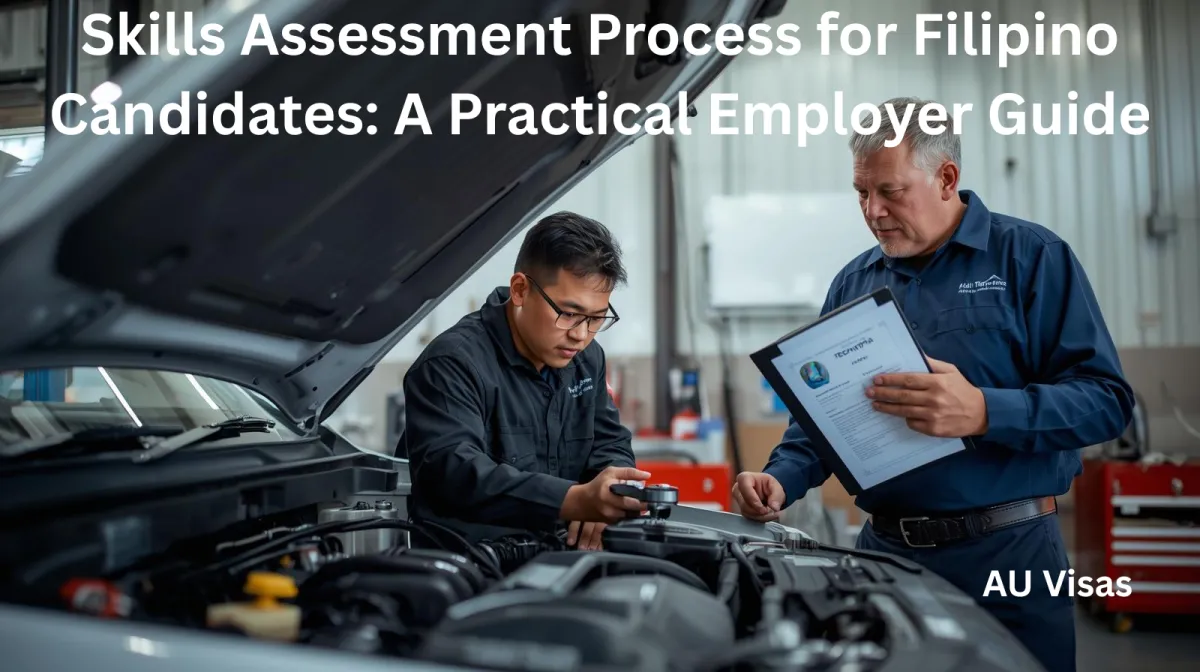
Skills Assessment Process for Filipino Candidates: A Practical Employer Guide
Filipino workers have earned a strong reputation across regional Australia for their reliability, technical skills, and work ethic. For many occupations, however, the Australian migration system requires a skills assessment to verify the worker’s qualifications and experience before a sponsored visa or permanent residency pathway can progress.
As someone who has hired and worked alongside skilled tradespeople myself, I find employers often misunderstand this step. Some believe it’s a minor paperwork formality; others fear it’s an impossible hurdle. The truth sits comfortably in the middle: the process is detailed, but predictable once you understand what assessors look for.
This guide is designed to give employers a clear, practical overview of what happens in a skills assessment, who conducts it, when it is required, and how it fits into the broader sponsorship journey—without giving immigration advice.
What Is a Skills Assessment and Why Does It Matter?
A skills assessment is an independent evaluation confirming that a worker’s:
qualifications
employment history
training
hands-on skills
meet Australian industry standards for their occupation.
This protects both employers and the integrity of the migration system by ensuring sponsored workers can perform the duties expected of them.
The Department of Home Affairs provides a high-level explanation here:
https://immi.homeaffairs.gov.au/visas/working-in-australia/skills-assessment
Where Skills Assessments Fit in the Visa Process
Whether a skills assessment is required depends on:
The occupation
The worker’s passport country
The visa type
Whether the applicant is offshore or onshore
Temporary Skill Shortage Visa (Subclass 482)
For the Subclass 482 visa (sometimes called the Temporary Skill Shortage or “TSS” visa), the rules for mandatory skills assessments come from this legislative instrument:
Migration (IMMI 18/039: Mandatory Skills Assessment—Subclass 482 Visa) Instrument 2018
https://www.legislation.gov.au/Details/F2018L00294
This instrument specifies:
Which occupations require a skills assessment
The passport countries for which it is mandatory
When it must be completed (typically before visa lodgement)
For many Filipino trades—such as welder, metal fabricator, and automotive technician—a skills assessment is required upfront.
If No Skills Assessment Is Required for 482
If an occupation is not listed in IMMI 18/039:
The Department of Home Affairs will verify skills and experience through the nomination.
Employers still need to demonstrate at least two years of relevant experience.
The evidence standard remains high—just without a third-party assessor.
Permanent Pathways (Subclass 186, 494 → 191)
Skilled permanent residency pathways rely on separate legislative instruments, including:
Migration (LIN 19/051: Specification of Occupations and Assessing Authorities) Instrument 2019
https://www.legislation.gov.au/Details/F2019L00278
And the updated framework:
Migration (Specification of Occupations and Relevant Assessing Authorities) Instrument 2024
https://www.legislation.gov.au/F2024L01618/latest/text
These instruments outline:
Which occupations require skills assessments
The relevant assessing authority for each occupation
Whether licensing, experience, or qualification checks apply
Most employers complete the skills assessment early to avoid delays later in the visa pathway.
Who Conducts Skills Assessments?
Different occupations are assessed by different authorities, as set out in the legislative instruments above.

The Offshore Skills Assessment Program (OSAP)
Many Filipino trades fall under the Offshore Skills Assessment Program, administered by Trades Recognition Australia:
OSAP information: https://www.tradesrecognitionaustralia.gov.au/programs/offshore-skills-assessment-program-osap
Who Conducts the Test?
TRA approves Australian Registered Training Organisations (RTOs) to run assessments.
These RTOs operate assessment centres in the Philippines, mainly Manila.
Technical interviews may occur online.
Practical testing happens in person.
Who Books the Test?
The RTO, not the employer, schedules the assessment.
Candidates apply to TRA, receive approval, and then the RTO contacts them.
Step-by-Step Skills Assessment Process
Step 1: Document Collection
Candidates gather:
Qualifications and training certificates
Employment records
Payslips and tax documents
Passport
Evidence of work (photos, videos, job logs)
Certificates of Employment (COEs) - common in the Philippines, confirming job titles, dates, and duties
Common employer issue: COEs often lack detailed job duties. Assessors need clear, duty-aligned descriptions to map work experience against Australian standards.
Step 2: Verification
Assessors check:
Qualification authenticity
Employment evidence
Whether duties match the Australian and New Zealand Standard Classification of Occupations (ANZSCO)
Whether employers are legitimate
Your Role as the Employer
Assessors may contact you to confirm:
Job duties
Employment conditions
Your understanding of the worker’s past experience
Timely, consistent responses prevent delays.
Step 3: Technical Interview
This is conducted by an Australian assessor and typically covers:
Tools used
Techniques and processes
Safety procedures
Job planning and troubleshooting
It confirms theoretical and practical understanding.
Step 4: Practical Assessment
Conducted in Manila or Cebu (depending on the RTO), this hands-on test replicates real workplace tasks.
Trades commonly assessed include:
Welder
Metal Fabricator
Automotive Mechanic
Diesel Mechanic
Refrigeration Mechanic
Carpenter
Chef
Australian industry-level accuracy and safety standards apply.
Step 5: Outcome Issued
A positive skills assessment is needed for:
Some Subclass 482 visa applications
The Subclass 494 Skilled Employer Sponsored Regional visa
Permanent residency pathways
Skills Assessment vs. Australian Licensing (Critical Distinction)
A skills assessment is not an Australian licence.
A positive skills assessment:
Confirms the worker meets migration skill standards
Allows a visa application to proceed
It does not permit the worker to perform licensed trade work.
Examples:
Electricians must complete state-based licensing (including gap training and supervised work).
Plumbers require state registration or licensing after arrival.
Employers must factor licensing into onboarding plans and timelines.
Costs and Timeframes
The cost of a full skills assessment for Filipino workers varies by occupation and assessing authority, but for most trade occupations assessed under the Offshore Skills Assessment Program (OSAP) or VETASSESS trade pathways, employers should expect a total cost above AUD $5,000.
For example, the VETASSESS fee schedule for Motor Mechanic (General) under the Subclass 482 (Temporary Skill Shortage) visa shows:
Documentary Assessment: $1,120
Technical Interview: $2,000
Practical Assessment: $2,200
Total government fee: AUD $5,320
This reflects the modern cost structure for overseas-qualified tradespeople undergoing three assessment stages.
In addition to government fees, employers and workers should also consider:
assessing partner or RTO administration fees
travel and accommodation to Manila or Cebu
time off work for the candidate
support services for document preparation
potential reassessment fees
Realistically, the full cost of a skills assessment project is often between AUD $5,500 and $8,500+, depending on the occupation and circumstances.
Typical Timeframes
Document checks: 4–8 weeks
Interviews/practical tests: 3–6 weeks
Final outcome: 2–4 weeks
Total: usually 2–4 months.
Common Pitfalls Employers Should Expect
Philippine COEs without detailed duties
Job titles not matching ANZSCO
Gaps in employment history
Delays in employer verification
Worker nerves during interviews
Outdated or missing certificates
Hypothetical example:
A worker recorded as “factory worker” may have been welding daily. Assessors need explicit welding evidence to classify them correctly.
Transparency Disclaimer for All Links
We include official legislative links so employers can verify information directly at the source. These links are for transparency only and should not be interpreted as migration or legal advice. For individual guidance, speak with a Registered Migration Agent or lawyer. https://auvisas.au/free-consult
Glossary of Key Terms
Skills Assessment – Independent verification of a worker’s skills, experience, and qualifications.
Trades Recognition Australia (TRA) – Primary assessing authority for trade occupations, including OSAP.
Offshore Skills Assessment Program (OSAP) – TRA’s program for assessing offshore-trained workers.
VETASSESS – Assessor for many non-trades and some trades.
Australian Computer Society (ACS) – Assessor for IT occupations.
ANZSCO – Australian and New Zealand Standard Classification of Occupations, used to match duties to occupation types.
Certificate of Employment (COE) – A standard Philippine document confirming job title, dates, and duties.
Nomination – Employer’s application requesting approval to fill a skilled position with an overseas worker.
Standard Business Sponsorship (SBS) – Approval for employers to nominate workers for certain visas.
Permanent Residency (PR) – Long-term visa status.
Related Articles
Related Articles that you may enjoy:
https://auvisas.au/post/becoming-a-business-sponsor
https://auvisas.au/post/common-visa-mistakes
https://auvisas.au/post/labour-market-testing
https://auvisas.au/post/costperday
https://auvisas.au/blog
Disclaimer
The content provided is for informational purposes only and does not constitute immigration or legal advice. It is subject to change. Consult a MARA-registered migration agent or lawyer for professional advice before making any application.
👉 Contact AU Visas today for a professional opinion on your situation. https://auvisas.au/free-consult


