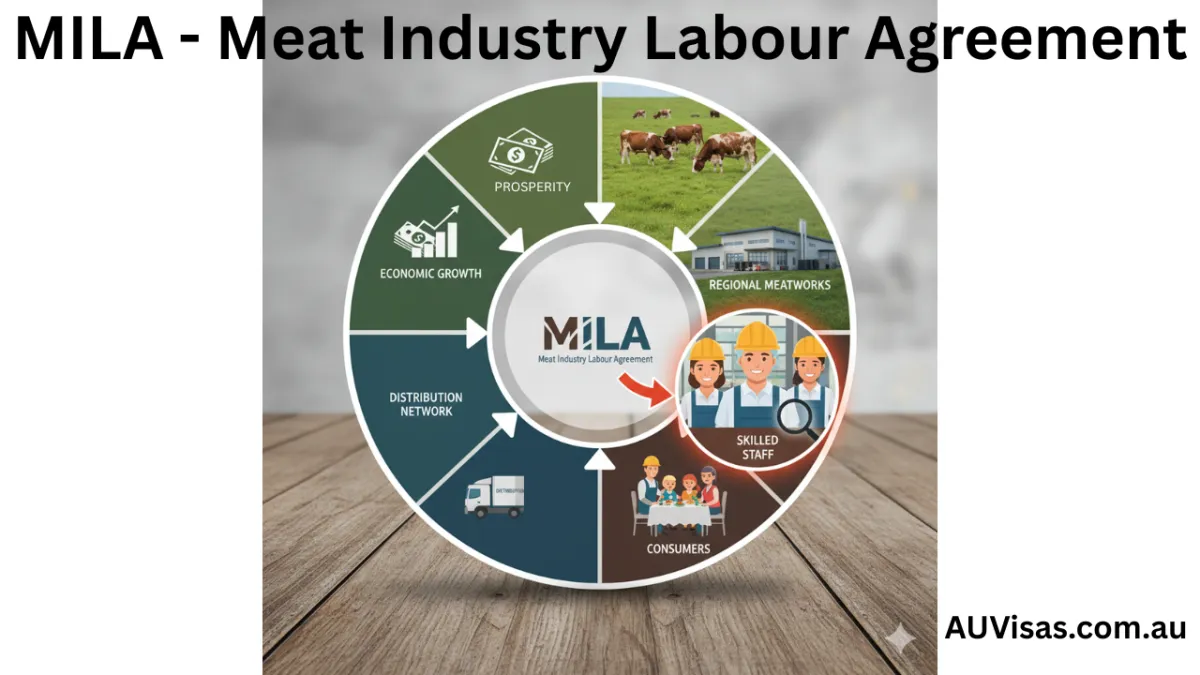
The Meat Industry Labour Agreement (MILA) — A Real Solution for Regional Abattoirs
Running a regional abattoir or meat processing plant has never been more challenging.
The skilled labour shortage isn’t just slowing production - it’s limiting growth, contracts, and profitability.
That’s exactly why the Meat Industry Labour Agreement (MILA) exists.
It’s a targeted, government-endorsed agreement designed to help meat industry employers fill critical roles with skilled overseas workers - lawfully, sustainably, and with long-term retention built in.
Why the MILA Exists
The MILA was created in direct response to ongoing, Australia-wide shortages of skilled boners, slicers, and slaughterers - occupations essential to keeping regional meat processors running at full capacity.
Standard visa pathways often exclude these roles due to their physical, trade-based skillsets. The MILA fixes that problem by providing industry-specific concessions that make it appropriate and achievable for regional businesses to sponsor skilled meat workers and maintain compliance.
The MILA Advantage for Regional Employers
1️⃣ Targeted Occupations
The MILA focuses on one core occupation: Skilled Meat Worker (ANZSCO 070499) — which covers qualified boners, slicers, and slaughterers.
Each worker must demonstrate competency at a level equivalent to the Australian Qualification Framework (AQF) Certificate III in Meat Processing, as benchmarked by MINTRAC (the Meat Industry National Training Advisory Council).
2️⃣ Visa Pathways Available
Employers under MILA can access several key visas:
482 Temporary Skill Shortage (TSS) Visa – Up to 4 years, fast-tracked staffing solution.
494 Skilled Employer Sponsored Regional (SESR) Visa – 5 years, with a regional focus and permanent residency potential.
186 Employer Nomination Scheme (ENS) – The permanent residency outcome, once qualifying criteria are met.
Together, these visas provide both immediate capacity and long-term stability for regional businesses.
3️⃣ Industry-Specific Concessions

✅ Important: Workers must always be paid the Annual Market Salary Rate (AMSR) — even where the 10% TSMIT concession applies.
Pathway to Long-Term Stability
The MILA is not a quick fix; it’s a structured workforce solution.
After gaining experience under a 482 or 494 visa, workers may be eligible for permanent residency through the 186 Employer Nomination Scheme — usually after 3 years of full-time employment in the nominated role.
This creates a powerful incentive for retention and local integration. Workers who see a future in your business become long-term contributors to your team and community.
Understanding the Real Costs

✅ Employer Tip: Labour Agreements like the MILA often specify a cap on how many workers can be sponsored under your agreement. Plan ahead so your workforce needs fit within that ceiling.
Essential Compliance Obligations
To maintain an active Labour Agreement and avoid penalties, you must:
Engage in Union Consultation – Before approval, employers must consult with the relevant union (e.g. AMIEU) as part of the Labour Agreement request.
Provide Full-Time Employment – All sponsored workers must be employed on a full-time basis.
Maintain Records – Keep 5 years of evidence (payslips, rosters, AMSR calculations, training).
Notify Home Affairs – Report role or business changes, pay adjustments, or employment cessation.
Pay Repatriation Costs – Cover reasonable travel costs if a sponsored worker leaves Australia at their request or after termination.
These obligations protect both your business and the integrity of the program.
Why the MILA Matters for Regional Growth
When a regional processor operates below capacity, it’s not just a business problem — it’s a community problem.
Each skilled worker you sponsor supports:
Consistent production and output
Secure export and retail contracts
Reliable jobs for locals in transport, maintenance, and administration
Economic stability for your town
The MILA empowers employers to compete globally, grow sustainably, and keep jobs in the regions where they matter most.
Final Takeaway: The Practical Path to Growth
The Meat Industry Labour Agreement is one of Australia’s most successful, proven workforce programs.
It provides a clear, compliant, and sustainable solution for abattoirs and processors ready to grow.
When used strategically — with proper planning, union consultation, and compliance — the MILA delivers both staff stability and regional prosperity.
Next Step:
Check your eligibility and begin your Labour Agreement consultation process.
A Registered Migration Agent experienced in MILA applications can guide you through every step from consultation to the first sponsored worker arrival.
Related Articles that you may enjoy
Source: AU Visas Employer Guide Series
Disclaimer
The content provided is here is for informational purposes only and does not constitute immigration or legal advice. It is subject to change. Consult an Australian MARA registered agent or lawyer for professional advice before making any application
👉Contact AU Visas today for a Professional Opinion on Your Situation.
Glossary of Key Terms
Meat Industry Labour Agreement (MILA)
A sector-specific Labour Agreement that allows eligible meat processing employers to sponsor skilled overseas meat workers on tailored visa terms, including concessions and defined pathways to permanent residency.Skilled Meat Worker (ANZSCO 070499)
The occupation used under the MILA to cover qualified boners, slicers and slaughterers who meet Australian industry benchmarks for skill and productivity.Boner / Slicer / Slaughterer
Specialist meat processing workers responsible for boning, slicing and slaughter operations in abattoirs and processing plants, often performing physically demanding and highly skilled tasks at commercial speeds.MINTRAC (Meat Industry National Training Advisory Council)
The national training advisory body for the Australian meat industry, responsible for setting skill benchmarks and standards, including those used to assess competency for skilled meat workers.AQF Certificate III in Meat Processing
An Australian qualification level that reflects a trade-level standard of skill in meat processing. Under the MILA, workers must demonstrate competency at this benchmark, even if they gained their experience overseas.Standard Business Sponsorship (SBS)
Approval granted by the Department of Home Affairs that permits an Australian business to sponsor overseas workers on certain employer-sponsored visas for a defined period, usually up to five years.Labour Agreement
A negotiated arrangement between an employer, industry group or region and the Australian Government that allows access to additional occupations and concessions beyond the standard skilled visa framework. The MILA is one such Labour Agreement.Labour Market Testing (LMT)
The requirement for employers to advertise positions in specific ways to show a genuine effort to recruit suitably qualified Australian workers before sponsoring overseas candidates.TSMIT (Temporary Skilled Migration Income Threshold)
A minimum income threshold used in skilled migration to ensure that sponsored workers are paid at an appropriate, non-exploitative level. Under the MILA, limited concessions may allow salaries up to 10% below TSMIT, subject to AMSR and agreement conditions.AMSR (Annual Market Salary Rate)
The market rate for a role, based on what an equivalent Australian worker would earn in that position and location. Employers must always pay at least the AMSR, even where a TSMIT concession exists.Category 2 & Category 3 Regional Areas
Government classifications of regional locations that can be relevant to migration settings. Under the MILA, more generous age concessions for permanent residency may apply in these higher-priority regional categories.Temporary Skill Shortage (TSS) Visa – Subclass 482
A temporary employer-sponsored visa that allows businesses to bring skilled overseas workers into Australia when they cannot find suitably qualified local staff, typically for up to four years.Skilled Employer Sponsored Regional (SESR) Visa – Subclass 494
A provisional regional visa that allows employers in designated regional areas to sponsor skilled workers for up to five years, with a pathway to permanent residency through the 191 visa.Employer Nomination Scheme (ENS) – Subclass 186
A permanent residency visa that allows approved employers to nominate skilled workers for PR. Under the MILA, the 186 Labour Agreement stream is often used as the long-term outcome for skilled meat workers.Union Consultation (e.g. AMIEU)
A mandatory step in many meat industry Labour Agreement processes where employers must consult with the relevant union, such as the Australasian Meat Industry Employees Union, before or during their Labour Agreement request.Repatriation Costs
The reasonable cost of travel for a sponsored worker to return to their home country or an agreed destination in certain circumstances, which sponsoring employers may be required to cover under their obligations.Cap (Worker Ceiling)
A limit on the number of sponsored positions that an employer can fill under a Labour Agreement. The cap is typically set out in the agreement and should be factored into long-term workforce planning.


