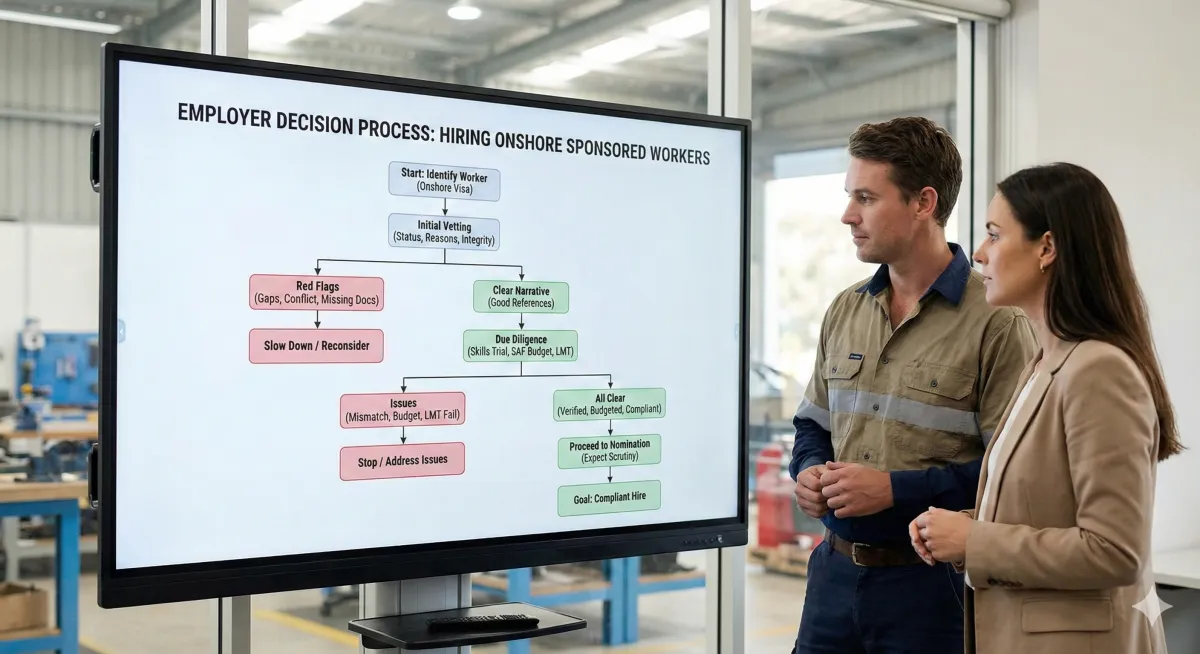
Hiring a Sponsored Worker Already in Australia: What Employers Need to Know
For many regional employers, this situation feels like a shortcut.
A skilled worker is already in Australia.
They already know the industry.
They’re already working locally.
And they’re “open to work”.
But from a risk and compliance perspective, this is one of the most misunderstood hiring scenarios in the sponsorship system.
This article explains - in plain English - how the system actually works, what should already be in place before a worker approaches you, what the previous employer may do, and what experienced migration agents and the Department typically scrutinise in practice.
This is not immigration advice.
It is commercial risk education for employers.
The Employer Checklist (Read This First)
Before you spend time, money, or goodwill on a sponsored worker already in Australia, work through this checklist.
You’ll find each item explained in detail as the article progresses.
Initial Employer Due Diligence Checklist
⬜ What visa are they on, and what work condition applies (e.g. tied to sponsor)?
⬜ Are they still employed, resigned, or terminated?
⬜ Can they clearly explain why they are leaving their current sponsor?
⬜ Can they provide a Statement of Service or Separation Certificate?
⬜ Has there been any dispute or complaint from the previous employer?
⬜ Do their skills genuinely meet your operational needs (not just on paper)?
⬜ Have you budgeted for all costs, including the SAF levy?
⬜ Are you prepared to run Labour Market Testing, even though they are already local?
⬜ Can your business wait months if scrutiny or delays arise?
If several of these boxes raise concerns, the safest move is to slow down before proceeding.
Why This Scenario Attracts Extra Scrutiny
When a worker on a sponsored visa seeks to change employers, three things happen at once:
Their visa conditions remain active
Their previous employer may still engage the Department
The new nomination is assessed with context, not in isolation
In practice, change-of-sponsor cases are often looked at more closely than first-time offshore hires.
The Legal Reality (In Plain English)
Most employer-sponsored visas include conditions such as 8607 or 8579, which broadly mean:
The worker can only work for their approved sponsor
They cannot start with a new employer until a new nomination is approved
Leaving an employer does not automatically cancel the visa
Extended periods without a sponsor can create risk
There is no automatic right for a worker to freely move between sponsoring employers.
What Should Already Be in Place on the Worker’s Side
1. Employment status (and proof)
A prudent employer should establish:
Are they still employed?
Have they resigned or been terminated?
How long have they been without sponsored employment?
Practical safeguard:
If the relationship with the previous employer is strained or hostile, ask the worker for a Statement of Service or Separation Certificate.
This is a neutral document confirming:
dates of employment
role title
core duties
If the worker cannot produce even this basic proof of tenure, it is a commercial red flag.
2. A clear and consistent reason for leaving
The Department rarely reacts well to vague or emotional explanations.
Lower-risk explanations usually involve:
redundancy or business closure
documented workplace issues
genuine relocation or housing problems
role or pay mismatch supported by facts
High-risk explanations tend to be:
inconsistent stories
sudden exits shortly after visa approval
unresolved disputes with no documentation
3. Integrity of the original application
If incorrect information, misleading statements, or false documents existed in the original process, this can surface later - sometimes years later.
When that happens, the new employer inherits the problem, not the old one.
What the Previous Employer Can (and Sometimes Does) Do
Legally, a previous employer:
cannot cancel the visa themselves
but can raise concerns with the Department
and may pursue civil action under employment law
In practice:
some complaints go nowhere
some trigger prolonged scrutiny
some cause long nomination delays
some derail applications entirely
There is no guaranteed pattern - which is why employer caution matters.
What Experienced RMAs Typically Look For (General Observations)
Without providing advice, experienced practitioners often assess:
does the move make commercial sense?
is the explanation consistent and evidence-based?
are there unresolved disputes?
does the role genuinely match the occupation?
does the new employer appear prepared and informed?
Applications that “don’t add up” often stall - sometimes until the worker’s visa expires.
What the New Employer Should Check (Before Nomination)
1. Skills verification in practice
Resumes are not enough. Are they actually what you are looking for?
Common checks include:
practical interviews
on-site assessments (where lawful)
supervisor input
evidence of hands-on competence
2. Commercial logic and costs
Ask yourself:
Why are we the solution?
Is this role long-term and defensible?
Can we support this worker if scrutiny increases?
Are we budgeted for all sponsorship costs?
⚠️ The Hidden Cost Trap: The SAF Levy
A common misconception is that hiring someone already in Australia is “cheaper”.
It may not be, although you do save on the flights.
The Skilling Australians Fund (SAF) levy:
attaches to the nomination, not the worker
does not transfer from the previous employer
must be paid again by the new employer
can be several thousand dollars, depending on turnover and nomination period
The previous employer may receive a refund (unlikely) - that does not help you.
3. Clean paper trail
Before proceeding, employers should ensure:
a clear written explanation from the worker
consistent timelines
no unexplained employment gaps
no contradictions across documents
4. Labour Market Testing (LMT) discipline - Myth-Buster
Common myth:
“They’re already here and doing the job, so I don’t need to advertise.”
Reality:
Unless an international trade obligation applies, Labour Market Testing is generally still required, even for a change of sponsor.
The Department usually expects:
compliant advertising
correct wording
appropriate duration
evidence that a local Australian could not fill the role
Poor or skipped LMT is one of the most common causes of delay.
Timing Reality: This Is Rarely a Fast Hire
In real-world conditions:
nomination approval may take months
the worker cannot legally start before approval
any “adverse information” can extend timeframes significantly
Employers who assume speed often end up exposed.
A Practical Employer Mindset
This scenario is not about stopping mobility.
It’s about asking one grounded question:
“If the Department reviewed this file in two years’ time, would our decision still make sense?”
If the answer is unclear, pause and reassess.
Glossary of Key Terms
Nomination
The employer application seeking approval to employ a specific worker in a specific role.
Condition 8607 / 8579
Visa conditions limiting a sponsored worker to employment with their approved sponsor.
Skilling Australians Fund (SAF) Levy
A levy paid by employers at nomination stage to support local skills training.
Labour Market Testing (LMT)
Evidence showing efforts to recruit local Australian workers before sponsoring.
Statement of Service
A document confirming dates of employment, role, and duties with a previous employer.
Related Articles (Internal Linking)
Related Articles that you may enjoy
https://auvisas.au/post/becoming-a-business-sponsor
https://auvisas.au/post/common-visa-mistakes
https://auvisas.au/post/labour-market-testing
https://auvisas.au/post/costperday
Source: AU Visas Employer Guide Series
Disclaimer
The content provided is for informational purposes only and does not constitute immigration or legal advice. It is subject to change. Consult a MARA-registered migration agent or lawyer for professional advice before making any application.
👉 Contact AU Visas today for a professional opinion on your business situation. https://auvisas.au/free-consult


