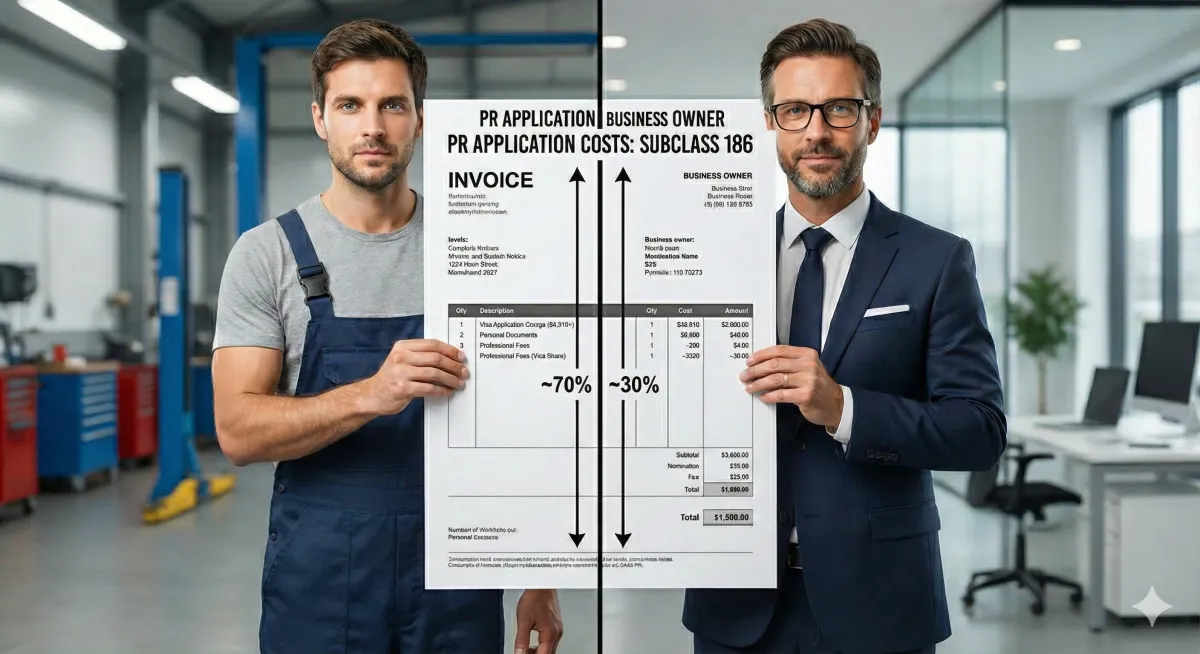
Who Pays for a Permanent Residency Application?
For regional employers, sponsoring a skilled worker isn’t just about filling a role - it’s about building a stable workforce in places where talent is genuinely hard to find.
By the time a sponsored employee reaches the 482-to-PR transition, you’ve often invested years in training, onboarding, and integration. That’s why one question carries more weight than most:
“Who pays for the permanent residency application?”
Handled well, this conversation can cement loyalty for years.
Handled poorly - or too late - it can trigger flight risk right at the finish line.
This guide explains:
What the law requires
What candidates typically pay
What experienced regional employers actually do
How to approach the discussion with confidence and clarity
This is general employer education, not migration advice.
The First Critical Update: The “2-Year Rule” (2024–2026 Reality)
Historically, many employers waited until a worker’s third year on a 482 visa to raise PR.
That thinking is now outdated.
Under current settings, many sponsored workers may transition to PR after just 2 years with the same employer.
Why this matters commercially
If you wait until year three to mention PR:
You may already be late
Competing employers may move earlier
Your employee may assume PR “isn’t coming”
Smart regional employers raise the PR conversation before the two-year mark.
What the Law Says (Non-Negotiables for Employers)
Some costs are strictly the employer’s responsibility. These are not negotiable.
1. The SAF Levy (Major Compliance Trap)
One-off payment for PR nomination
$3,600 for businesses under $10M turnover
$5,400 for businesses over $10M turnover
👉 It is illegal to pass this cost to the employee, directly or indirectly.
This includes:
Payroll deductions
“Reimbursements”
Side agreements
If there’s one cost to get right, it’s this one.
2. The Nomination Fee - Regional Advantage
Standard nomination fee: $540
Often waived ($0) for regional employers under the TRT stream
It’s a small saving, but it reflects the policy advantage regional businesses have - and it’s worth knowing.
The Candidate’s Share (What Is Normal in 2026)
Unlike the initial 482 visa (which is largely employer-driven), PR is widely seen as a personal life outcome for the worker.
Most candidates typically pay for:
Visa Application Charge (VAC)
– approx. $4,910 for the main applicant
– additional fees for partners and childrenHealth checks
Police clearances
English testing (if required)
This is standard practice, not a red flag.
Professional Migration Fees: The Fair & Common Split
This is where confusion - and resentment - often starts.
A PR application involves two separate legal tasks.
1. The Nomination (Business Side)
This covers:
Your role
Your financials
Your ongoing position
Common practice:
👉 Employer pays the agent’s nomination fee
This makes sense - it’s your business information.
2. The Visa Application (Personal Side)
This covers:
The worker’s visa
Family members
Personal history and documents
Common practice:
👉 Candidate pays the agent’s visa lodgement fee
This split is widely viewed as fair, transparent, and defensible.
What Do Candidates “Deserve”? (The Retention Lens)
Legally, an employer could require the candidate to pay almost everything except the SAF levy.
But experienced regional employers think bigger than minimum compliance.
The “Golden Handcuff” Approach (Common in Practice)
Many employers:
Pay all professional fees upfront
Use a cost-recovery clause in the employment contract
Example structure (hypothetical):
Employer covers nomination + visa agent fees
Agreement states:
If the employee leaves within 2 years of PR grant
They repay a pro-rata portion of those costs
This:
Reduces flight risk
Feels fair to the employee
Protects the business investment
The PR Process at a Glance (Employer View)
Early discussion (before the 2-year mark)
Confirm ongoing role and performance
Agree on cost structure (no surprises)
Nomination lodged by employer
Visa lodged by employee
(often at the same time for speed)Ongoing employment and retention
The cost conversation belongs at Step 1, not Step 4.
Final Advice for First-Time Sponsors
The PR transition is the highest-risk moment for losing a good worker.
Transparency beats generosity.
Clarity beats silence.
When employers:
Explain the rules early
Split costs fairly
Show commitment without over-promising
They don’t just get a PR outcome -
they keep a skilled worker long after it’s granted.
Glossary of Key Terms
PR (Permanent Residency)
The right to live and work in Australia indefinitely, subject to conditions.
482 Visa
A temporary employer-sponsored visa allowing skilled workers to work for an approved sponsor.
Nomination
The employer’s application to confirm the role is genuine and ongoing.
SAF Levy
A government levy paid by employers when nominating sponsored positions.
TRT Stream
A pathway allowing sponsored workers to transition from temporary to permanent status.
Related Articles
Related Articles that you may enjoy
https://auvisas.au/post/becoming-a-business-sponsor
https://auvisas.au/post/common-visa-mistakes
https://auvisas.au/post/labour-market-testing
https://auvisas.au/post/costperday
https://auvisas.au/blog
Source: AU Visas Employer Guide Series
Disclaimer
The content provided is for informational purposes only and does not constitute immigration or legal advice. It is subject to change. Consult a MARA-registered migration agent or lawyer for professional advice before making any application.
👉 Contact AU Visas today for a professional opinion on your situation. [email protected]


