
Subclass 400 Visa: 2026 Employer Guide
If you run a regional manufacturing, construction or agricultural business, you know how this plays out:
• A critical machine fails
• A factory line needs commissioning
• A shutdown window is locked in
• A specialist must attend from overseas
You don’t need a permanent employee.
You need a genuine specialist - fast.
The Temporary Work (Short Stay Specialist) visa (subclass 400) can be the right tool for that situation.
But in 2026, it’s also one of the most misunderstood visas - and one the Department of Home Affairs now scrutinises heavily.
This guide reflects the 2024–2026 reforms and explains:
What the 400 visa is (and isn’t)
What must happen first
Updated costs
The new “one-and-done” rule
When the Department will push you toward the Skills in Demand (SID) visa instead
No scare tactics. Just practical clarity for regional operators.
What Is the Subclass 400 Visa?
The Subclass 400 visa is for:
Highly specialised, short-term, non-ongoing work in Australia.
It is not a standard sponsorship visa.
Unlike the Skills in Demand visa (subclass 482), the 400 visa:
Does not require Standard Business Sponsorship (SBS)
Does not attract a Skilling Australians Fund (SAF) levy
Is not designed for ongoing roles
Has no pathway to permanent residence
It is a short, sharp commercial solution - not a workforce strategy.
2026 Policy Reality: The Department Is Watching
Following migration reforms in late 2024 and 2025, the Department is actively targeting:
“Backdoor” use of the 400 visa
Repeated short-term entries
Trade roles disguised as “specialists”
Situations that look like normal employment
If the role resembles a standard job, they will generally expect you to use the SID (Subclass 482) framework instead.
The “One-and-Done” Rule (Major Trap)
One of the biggest changes regional employers must understand:
In practice, 400 visa holders are generally limited to one stay period within a 12-month window.
That means:
If you bring a technician for 3 months, you usually cannot bring that same person back 4 months later for another “short-term” project.
This is critical for businesses with:
Recurring maintenance needs
Seasonal commissioning cycles
Ongoing offshore manufacturer involvement
The 400 visa is not designed for repeat rotations.
Planning matters.
Maximum Stay: 3 Months Is the Real Benchmark
The legislation allows up to 6 months in limited cases.
However, in 2026:
Anything over 3 months attracts serious scrutiny
A 6-month request generally requires an exceptional business case
If the work resembles normal employment, the Department will likely direct you toward the SID (482) pathway
As a practical benchmark:
If your project genuinely fits inside 3 months, the 400 may be viable.
If it stretches toward 6 months, expect resistance.
Updated 2025/26 Costs
Government Visa Application Charge (VAC)
As of July 2025 indexation:
AUD 430 per applicant
(Subject to future indexation.)
No SAF Levy
Unlike the Skills in Demand visa:
There is no Skilling Australians Fund levy
No ongoing sponsorship costs
Business Costs to Factor In
Flights
Accommodation
Insurance
Salary or contractor payments
Downtime risk if delayed
The government fee is low.
The commercial risk of refusal is not.
What Needs to Happen First?
The user question was direct:
“Is there anything that needs to happen first?”
Yes - and this is where many applications fail.
1️⃣ The Invitation Letter (Most Important Document)
With the 400 visa, you do not “sponsor.”
You invite.
The Invitation Letter must clearly explain:
The exact project
Why it is non-ongoing
Why the worker is highly specialised
Why their skills are not readily available locally
Exact start and end dates
For example (hypothetical):
“Only this factory-certified engineer has proprietary source code access for commissioning this pellet mill model.”
That level of specificity matters.
2️⃣ Offshore Requirement
The worker must be:
Outside Australia when the application is lodged
Outside Australia when it is granted
You cannot “flip” someone already in Australia on a tourist visa into a 400 visa.
That is a common and costly misunderstanding.
3️⃣ Labour Market Testing – The Nuance
There is no formal 4-week advertising requirement like under the SID (482) visa.
However:
You must still demonstrate the skills are not readily available in Australia.
For regional employers, that often means showing:
Proprietary knowledge
Factory certification
Unique technical authorisation
Manufacturer-mandated attendance
If it’s simply “an experienced fitter” or “a good tiler,” it will likely fail.
Trade Workers: Highest Scrutiny Area
This is particularly important for:
Tilers
Mechanics
Electricians
Fitters
Welders
If the role looks like a standard trade position, the Department will generally assume it belongs under the SID (482) framework.
The 400 visa is typically successful for:
✔ Factory-certified installers
✔ Commissioning engineers
✔ Specialist software technicians
✔ Warranty-authorised experts
Not general labour shortages.
400 vs Skills in Demand (SID) Visa – Quick Comparison
Regional business owners like clarity. Here it is:
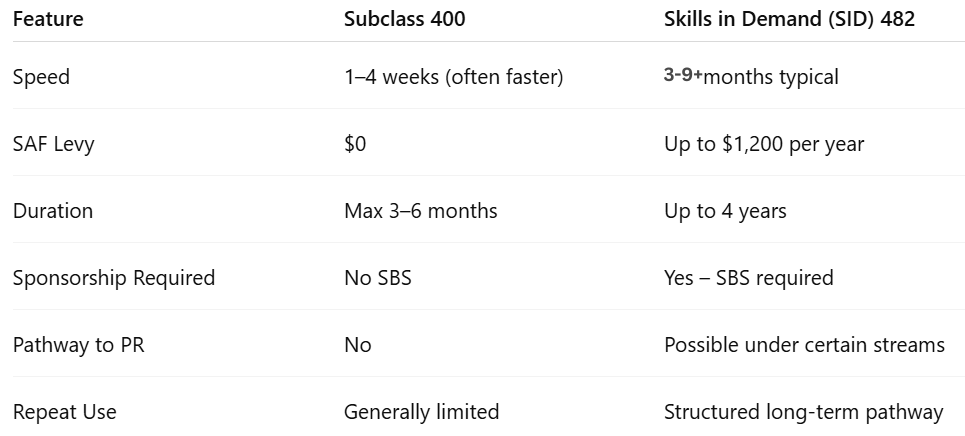
If you need a long-term tradesperson - the SID visa is the proper framework.
If you need a short-term proprietary specialist - the 400 may fit.
When the 400 Visa Works Well
✔ Equipment commissioning
✔ Warranty repairs
✔ Specialist shutdown work
✔ Overseas manufacturer attendance
✔ Defined project with fixed end date
When It Doesn’t
✖ Ongoing trade roles
✖ Labour shortages
✖ Seasonal repeat work
✖ Anything that looks like a normal job
A Regional Business Mindset
Think of the Subclass 400 as:
A short-term technical intervention.
Not:
A hiring shortcut
A sponsorship workaround
A rotating labour model
Used correctly, it protects projects.
Used incorrectly, it creates compliance exposure.
Glossary of Key Terms
Subclass 400
Short-term visa for highly specialised, non-ongoing work.
Skills in Demand (SID) Visa
Australia’s current employer-sponsored skilled visa framework (Subclass 482).
Standard Business Sponsorship (SBS)
Approval required to sponsor workers under the SID visa.
Skilling Australians Fund (SAF) Levy
Training levy payable for sponsored positions under the SID visa.
Invitation Letter
The formal document from the business explaining the short-term project and specialist requirement for a 400 visa applicant.
Related Articles
Related Articles that you may enjoy
https://auvisas.au/post/becoming-a-business-sponsor
https://auvisas.au/post/common-visa-mistakes
https://auvisas.au/post/labour-market-testing
https://auvisas.au/post/costperday
Source: AU Visas Employer Guide Series
Mandatory Disclaimer
The content provided is for informational purposes only and does not constitute immigration or legal advice. It is subject to change. Consult a MARA-registered migration agent or lawyer for professional advice before making any application. https://auvisas.au/free-consult for business.
👉 Contact AU Visas today for a professional opinion on your situation.


