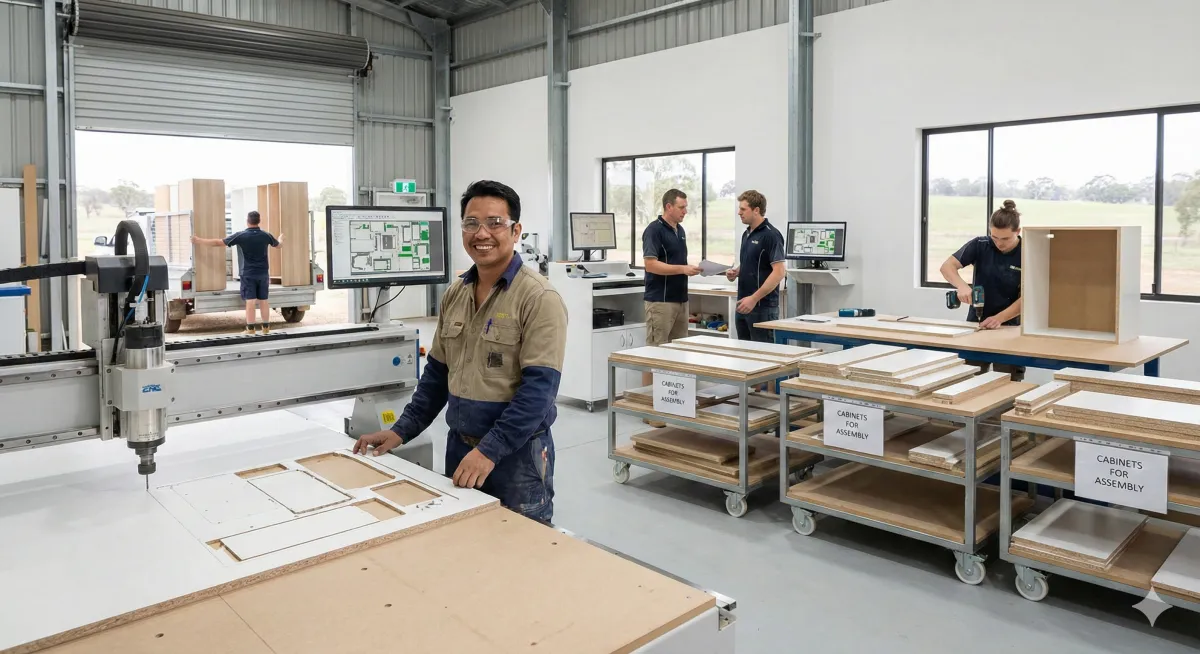
Cabinet Makers in Regional Australia: The Workforce Options Some Shops Don’t Realise They Have
If you’re a regional cabinet maker, chances are you’re already doing the hard yards.
You’re quoting at night, juggling installs, keeping clients happy, and trying to keep the factory moving - all while apprentices are thin on the ground and good local trades can resign at any moment.
Here’s the upfront message we want you to hear:
There are experienced cabinet makers available globally right now - including CNC-capable operators - and with the right process, regional employers can bring stable skilled labour into their workshop.
This isn’t a “too good to be true” promise. It’s a planning conversation.
AU Visas exists to help regional employers understand what’s possible, what the commercial risks are, and how to work with the right professionals (including MARA-registered agents) so the process is done properly.
Now, if you’d like the detail - trade classifications, how overseas experience compares to Australian training, how to vet for accuracy, and why “idle machines during installs” is a profit leak - read on.
The Regional Cabinet Shop Bottleneck
Most small cabinet shops don’t have a marketing problem. They have a capacity problem.
A common pattern looks like this:
You take on a few jobs (because you can’t afford quiet months)
Manufacturing runs hard… then stops
The whole team goes out to install
The CNC and edge-bander sit idle (dead capital)
Jobs get “drip-fed” to multiple clients to keep everyone calm
One kitchen turns into a February-to-September saga
That’s not because the owner doesn’t care. It’s because the workflow is forced into stop-start mode when you don’t have enough stable hands to split production and install roles.
The good news: this is fixable - and it starts with workforce stability and better handover systems.
Occupation Codes Used for Cabinet Making (The Ones Employers Commonly Hear About)
Employers often ask “what code is a cabinet maker?”
In Australian occupation classification terms, cabinet making and joinery commonly falls under these ANZSCO trade occupations (exact fit depends on the duties in your business):
Cabinet Maker - ANZSCO 369131 Code link here
Joiner - ANZSCO 372131 Code link here
You may also hear older references like “Cabinetmaker 394112” in legacy systems and some industry material. The key point for employers: the nominated occupation must match the actual day-to-day duties.
How This Compares to an Australian Apprenticeship
Most cabinet making trade outcomes align broadly to AQF Certificate III-level competency in terms of what a qualified tradesperson can do on the tools.
The important employer lens is this:
An Australian apprentice is a future asset (but needs years of supervision)
An experienced overseas tradesperson is often an immediate productivity asset (if vetted properly)
That’s not anti-apprentice. It’s simply acknowledging the reality: many regional shops need output now, not in 2–3 years.
Common Source Countries for Cabinet Makers (Employer Reality)
You’ll see strong cabinet making and joinery talent coming from a mix of places depending on the type of work:
Philippines - often strong on production, machining, and CNC exposure. Good culture fit.
Vietnam - often experts in high-volume production, CNC operation, and automated finishing lines
UK / Ireland - strong joinery traditions + site standards mindset
South Africa - workshop discipline and practical adaptability
What matters more than passport: evidence of commercial workshop experience, quality mindset, and the ability to work in a system (drawings → CAD/CAM → cut list → CNC → install).
The “Right First Time” Question: Nobody Can Guarantee It - But Good Operators Can Prove Their System
Measurement mistakes are a killer. Not because people are dumb - but because the process allows errors to sneak in:
rushed site measures between installs
“verbal variations” from the client or builder
re-typing measurements from paper into software
no single source of truth for drawings
cutting before sign-off
So instead of asking a candidate to “guarantee accuracy”, ask them to explain the system that makes mistakes unlikely.
The One Vetting Question That Exposes Skill Fast
“Talk me through your process from site measure to CNC file - where can errors happen, and what do you do to prevent them?”
A high-quality operator will talk about controls, not confidence.
The 10 Best Vetting Questions for Cabinet Makers (Workshop + CNC Ready)
“Walk me through a job from measure to final install.”
“How do you check a room for out-of-square and how do you allowance for it?”
“Which CAD/CAM tools have you used, and what files do you send to the CNC?”
“How do you prevent transcription errors between site notes and software?”
“What’s your sign-off point before cutting starts?”
“Explain how you handle fillers, scribing, and tolerance planning.”
“What’s your process for appliance specs, hinges, and hardware schedules?”
“What does a good cut list look like, and who owns it?”
“Tell me about a rework you had - what caused it and what changed after?”
“If the installer finds an issue on-site, what’s your fix workflow?”
Good candidates give structured answers. Weak candidates lean on “I’m careful” and “I’ve been doing it for years”.
As always, request videos of them in action for each stage you are interested in.
The “Closed-Loop” Accuracy System (What Strong Candidates Describe)
If you want fewer reworks, look for these signals:
1) One Source of Truth
Measurements go straight into the job file (CAD), not into scattered notes.
2) Squareness + Tolerances Are Documented
Good operators assume walls aren’t square - and plan for it on paper before cutting.
3) No Cutting Before Sign-Off
A disciplined shop treats sign-off as a hard gate, not a suggestion.
4) CAD → CAM → CNC With Minimal Manual Handling
The fewer times a human re-types a number, the fewer “5mm disasters”.
5) Production and Install Are Treated as Two Different Work Streams
When the whole team installs, machines stop. The best workshops aim to keep manufacturing running while installs happen (even if it’s just one person staying back).
Australian Standards and Compliance (High-Level, Practical)
This isn’t legal interpretation - but it’s smart operational awareness.
Cabinetry businesses commonly reference Australian Standards relating to cabinetry design, manufacture and installation, including AS 4386:2018 (Cabinetry in the built-in environment - Commercial and domestic).
You may also run into older domestic kitchen assembly references in training and historical materials (e.g., older AS/NZS 4386.x series).
Practical takeaway: standards knowledge can be taught. What’s harder to teach is a quality mindset that respects sign-offs, tolerances, and checking.
Old-School vs New-School Cabinet Making (And Why You Need Both)
Old-School Skills (Still Pay the Bills)
set-out discipline
solid timber fundamentals
hand finishing
problem solving on imperfect sites
New-School Capability (Now a Competitive Advantage)
CNC routing and nested manufacturing
CAD/CAM workflows
part labelling + assembly efficiency
3D renderings that lift sales conversion
revision control (reduces “verbal change” mistakes)
The sweet spot candidate: understands old-school fundamentals, but is comfortable operating in a modern data-driven workflow.
Imports Are Raising the Bar - So Local Shops Must Win on Speed, Fit, and Finish
Flat-pack and imported options aren’t going away.
Regional cabinet makers who thrive tend to focus on:
predictable lead times
fewer reworks
cleaner presentation and client experience
higher throughput from the same machines
reliable staff who stick around long enough to build a rhythm
This is where stable skilled labour can be a growth lever - not just a “fill a vacancy” exercise.
A Balanced Word on Retention and Stability
It’s true that many skilled migrants aim for long-term stability - they’re often relocating their lives and families, not just chasing the next $2/hr.
But the best way to think about it as an employer is simple:
Retention improves when the role is well-scoped, well-supported, and the workplace runs on systems - not chaos.
Good people (local or overseas) stay where they can do good work without constant firefighting.
Glossary of Key Terms
ANZSCO – Australia & NZ occupation classification system used to describe roles and duties.
AQF – Australian Qualifications Framework (Certificate III is a common trade benchmark).
CAD/CAM – Design-to-manufacture software workflow.
CNC – Computer Numerical Control machinery (routers, nested manufacturing).
Nested Manufacturing – Cutting many parts from one sheet efficiently, often CNC-driven.
Sign-off Gate – A formal approval point before cutting begins.
WHS – Work Health and Safety obligations in workshop and on-site installs.
18. Related Articles (Internal Linking)
Related Articles that you may enjoy
https://auvisas.au/post/becoming-a-business-sponsor
https://auvisas.au/post/common-visa-mistakes
https://auvisas.au/post/labour-market-testing
https://auvisas.au/post/costperday
Source: AU Visas Employer Guide Series
19. Mandatory Disclaimer
The content provided is for informational purposes only and does not constitute immigration or legal advice. It is subject to change. Consult a MARA-registered migration agent or lawyer for professional advice before making any application.
👉 Contact AU Visas today for a professional opinion on your situation.


