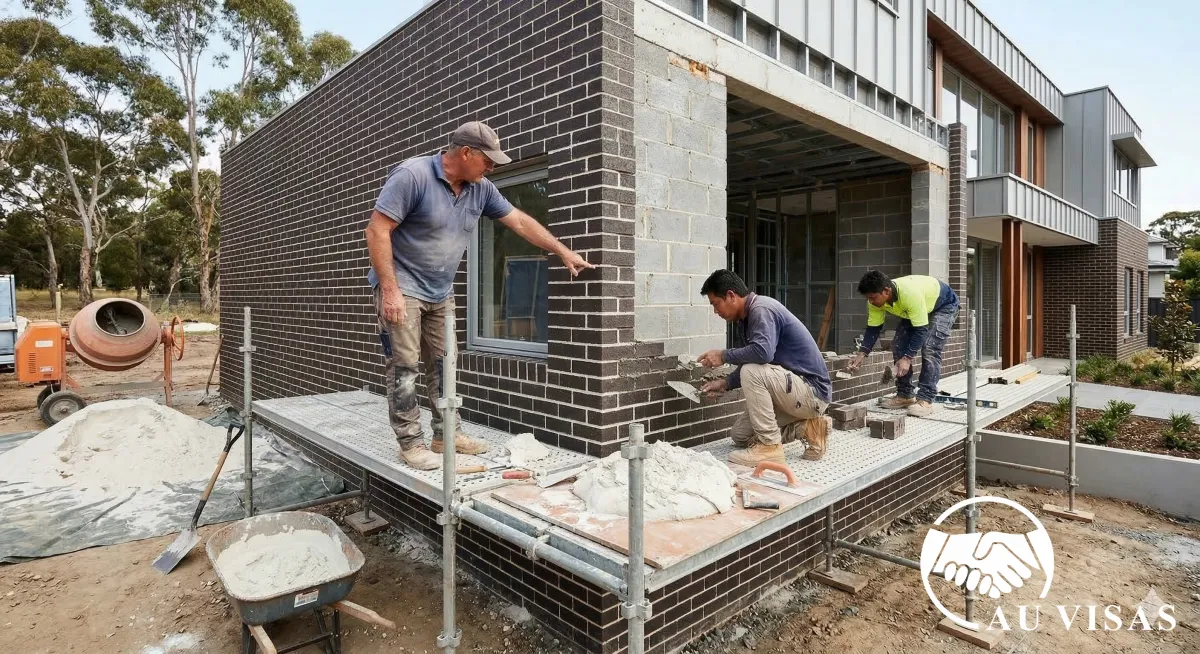
Can You Sponsor Bricklayers Into Australia? Yes — Here’s How
If you run a bricklaying business, building company, or regional construction outfit, chances are you have thought some version of this before:
“It’s too hard to bring in a bricklayer from overseas.”
That belief is common. But for many employers, it is more fear than fact.
Yes, there is a process involved. There are advertising rules, sponsorship steps, salary settings, skills evidence, and timing issues. But bricklayers are not some fringe occupation sitting outside the system. Bricklayer (331111) is on the Core Skills Occupation List, and Jobs and Skills Australia shows it as a national shortage occupation, not merely a regional-only one.
And the commercial backdrop is hard to ignore. Australia’s bricklaying workforce is not overflowing with young entrants. Jobs and Skills Australia shows bricklayers with a median age of 38, and around 20.1% of the occupation is already aged 55 or over. At the same time, construction trades are being squeezed by weak apprenticeship inflow, with JSA reporting construction trades worker groups are mostly in shortage due to a training gap, and apprenticeship commencements in that subgroup fell 16.0% from 2023 to 2024.
Against that backdrop, demand for productive bricklayers remains very real. The National Housing Supply and Affordability Council reported that 177,000 dwellings were completed in 2024, while underlying demand was around 223,000, and that new housing supply was near its lowest level in a decade.
So the plain-English message for bricklaying employers is this:
There is work.
There is a shortage.
There is a process.
And if you start early enough, this option is usually much more manageable than people think.
This article is general information only for employers. It is not immigration or legal advice, and visa rules, assessment settings and occupation lists should be assessed case by case.
The short answer: can bricklayers be sponsored into Australia?
Yes.
Bricklayer (331111) appears on the Core Skills Occupation List (CSOL), which the Department uses for the Core Skills stream of the Skills in Demand visa (subclass 482). The Department has also stated that the CSOL applies to the Direct Entry stream of the Employer Nomination Scheme visa (subclass 186).
Jobs and Skills Australia’s 2025 Occupation Shortage List also shows Bricklayer as S = Shortage, rather than merely a metro or regional-only shortage marker.
That is a useful confidence point for employers. It means bricklayers are not being squeezed into a narrow side door. They sit in the mainstream skilled migration conversation.
Is bricklayer on the main shortage list or just the regional shortage list?
It is on the main national shortage list.
That matters because employers may assume bricklayer is only sponsorable in a niche regional setting. The current shortage data says otherwise. Bricklayer is rated as a shortage occupation nationally, and the occupation is also on the CSOL used for mainstream employer-sponsored pathways.
So if a bricklaying employer is asking:
“Is this one of those occupations that only works in a weird regional exception?”
The answer is no.
Why this matters more now than it did a few years ago
A lot of bricklaying employers can feel the labour shortage without needing a government report to tell them. But the data does help explain why the pressure keeps hanging around.
There are really three forces at work:
1. The workforce is maturing
Jobs and Skills Australia shows about one in five bricklayers are already 55 or older.
2. The inflow is not strong enough
JSA says construction trades groups are mostly in shortage due to training gaps, and apprenticeship commencements in that subgroup fell 16.0% from 2023 to 2024.
3. Housing demand is still outpacing supply
The National Housing Supply and Affordability Council says housing supply in 2024 fell well short of demand, and forecasts a continued net shortfall over the Housing Accord period.
For a bricklayer or builder reading this, the commercial takeaway is pretty simple:
if you have reliable capacity, there is every chance the market will keep finding work for you.
That is exactly why more businesses are starting to think less like “Can we survive the paperwork?” and more like “How do we secure enough output to keep taking the jobs on?”
Is bricklayer on any DAMAs?
Yes.
Bricklayer appears on several DAMA occupation lists, including Orana DAMA and Murray DAMA. Orana’s current list includes 331111 Bricklayer and notes a pathway to permanent residence in that setting.
The practical caution is that a DAMA is never just about whether the occupation name appears on a list. Location, endorsement, salary settings, concession rules and local business eligibility all still matter. DAMA settings can also change.
So the useful employer mindset is:
occupation on list = promising
not
occupation on list = automatic
How many bricklayers are brought into Australia each year?
There is no single neat public official table that currently says, “Here is the total number of bricklayers brought in across every visa type in the last 12 months.”
Public numbers are fragmented across different releases. Older Home Affairs FOI material did show relatively low bricklayer grant numbers in some periods. That can make employers think the pathway must be impossible.
But that would be the wrong conclusion.
The more realistic interpretation is that bricklayer sponsorship has historically been underused, not impossible. Many businesses still rely on local labour, subcontracting, labour hire, or short-term visa holders already in Australia. Others simply never get organised early enough to use sponsorship properly. Meanwhile, Jobs and Skills Australia still shows about 16,700 people employed as bricklayers in Australia, and the occupation remains formally recognised as being in shortage.
At time of publishing there were 278 Bricklaying positions advertised just in NSW.
That is why a low historic grant number should not scare employers off. In many ways, it highlights that this remains an underused workforce planning tool for businesses willing to prepare ahead of time.
What countries are bricklayers commonly brought in from?
There is not a current official public “top countries for sponsored bricklayers” league table.
But there is a very practical clue in TRA’s current OSAP nominated occupations, countries and service providers settings. For Bricklayer (331111), TRA currently lists OSAP-linked access across countries including Brazil, Fiji, Hong Kong SAR, India, Macau SAR, Philippines, South Africa, Thailand, Vietnam and Zimbabwe.
That does not mean those are automatically the “top source countries” by grant numbers. It does, however, show the countries that sit in a real skills-assessment pipeline for this occupation.
From an employer point of view, the markets most often talked about in practice tend to include:
United Kingdom and Ireland for cultural fit and easier communication
Philippines for strong work ethic and broad construction experience, noting that English and assessment readiness still matter
South Africa for solid masonry and construction backgrounds
India and parts of Southeast Asia where brick and block work experience can be strong, provided the candidate can properly evidence it
That country view is a market observation, not a government ranking. The safer rule is still this:
good candidate evidence beats country stereotypes every time.
What is the Australian bricklaying code?
The standard Australian occupation code is:
Jobs and Skills Australia describes bricklayers as workers who lay bricks, pre-cut stone and other types of building blocks in mortar to construct and repair walls, partitions, arches and other structures.
Who is the skills assessment authority?
The official assessing authority is Trades Recognition Australia (TRA). TRA states that it offers skills assessment programs based on occupation, country of passport, where the person studied, and the visa type being sought. TRA also publishes the OSAP occupation and country settings for bricklayers.
TRA is the assessing authority
approved assessment providers may conduct practical or program-delivery components under TRA arrangements, depending on the pathway
What is the biggest difference between Australian bricklaying and overseas bricklaying?
It is the scope, quality expectations, safety habits, and the evidence needed to prove the skill.
A worker may say “bricklayer,” “blocklayer,” “mason,” or something similar overseas. But the Australian system wants to know whether the person’s real experience lines up with the occupation actually being nominated. In practice, employers should be checking for things like:
setting out from plans
cavity and veneer work
straightness, plumb and level
corners and openings
damp-proofing awareness
scaffold familiarity
finish quality and pace under Australian site conditions
the same as they would for any Australian applicant.
The other practical difference is climate and site rhythm. A bricklayer from the UK or Ireland may be highly capable, but a Griffith or regional NSW summer is a different proposition. Sun safety, hydration, heat management and earlier starts can be genuine adjustment points. That is not a reason not to hire them. It is simply part of onboarding them properly.
Are there different categories of bricklayers?
Yes in practice, though not usually as separate migration occupations.
Most employers will recognise different strengths such as:
house bricklayers
blocklayers
fence and pier specialists
retaining and feature wall workers
fireplace and chimney workers
repair and repointing workers
But those do not normally become different sponsored occupation codes in their own right. If the core work is genuine brick and block masonry, it usually still sits inside Bricklayer (331111).
Where the work shifts more heavily into cut stone, monumental masonry, or stone fabrication, Stonemason (331112) may be the more accurate occupation instead.
So the rule for employers is simple:
recruit and nominate based on the real work, not the broad label.
Is there a pathway to PR?
Yes, generally speaking, there are employer-sponsored permanent residence pathways connected to bricklayer roles.
The main ones employers usually think about are:
1. 482 first, then 186 later
Bricklayer is on the CSOL, and the Department has said the CSOL also applies to the Direct Entry stream of subclass 186.
2. 494 regional pathway, then 191
The Department states that a subclass 494 holder can apply for permanent residence after 3 years, and the subclass 191 page confirms that an eligible visa includes 494 and must have been held for at least 3 years.
Which visa types are most commonly used?
For employer-sponsored bricklayers, the practical list is usually:
Skills in Demand visa (subclass 482) — Core Skills stream
This is the main temporary employer-sponsored pathway for CSOL occupations like bricklayer.
Skilled Employer Sponsored Regional (subclass 494)
This is the key regional employer-sponsored option where the business and role fit the regional settings. It also offers a later PR pathway if eligible.
Employer Nomination Scheme (subclass 186)
This is the permanent employer-sponsored pathway, commonly discussed either through direct entry or after a temporary sponsored period, depending on the circumstances.
DAMA-based pathways
In DAMA regions, an employer may also have access to labour agreement settings and concessions not available in the standard pathway.
Is there a “try before you buy” option?
Not really, unless you find a candidatethat you could sponsor already here on a Working holiday visa. The WHM program is large, with Home Affairs reporting 206,187 WHM visa holders in Australia as at 31 December 2024. Historically not many of these are Brickies though.
A caution is important though: WHM visas normally carry condition 8547, which limits work with one employer to 6 months unless permission or an exemption applies.
So this can be a useful “test the fit” strategy, but it is not a substitute for proper long-term planning.
Most common is to witness the skills test, as a final check before you commit to an offshore candidate. Either in person, or via video link. Video portfolio's are also good.
What is the rough timeframe to bring in a bricklayer?
The visa itself may not be the slowest part
Home Affairs’ current published median for Skilled (Temporary) processing is 113 days.
The real bottleneck is often before lodgement
For bricklayers, the slower part can be getting the candidate genuinely assessment-ready and English-ready, especially if they need a TRA-linked skills assessment pathway and an English test result. TRA confirms that skills assessment programs vary by occupation, country of passport, place of study and visa type, and bricklayer sits inside active TRA assessment settings.
In practice, that means employers should not think in terms of “three weeks.” A realistic planning mindset is often:
time for recruitment and document gathering
time for assessment preparation
time for English testing if needed
time for labour market testing
time for nomination and visa processing
That is why the most useful employer advice is still:
start before you are desperate.
What needs to be in place ahead of time?
1. A real role and enough work
You need a genuine position, enough forward work, and the ability to supervise properly.
2. Sponsorship approval
If you are using the standard 482 or 494 pathway, you may need to be an approved Standard Business Sponsor first. SBS approval is generally valid for 5 years once granted.
3. Labour market testing
For most relevant nominations, Home Affairs says the role must be advertised for at least 4 weeks, in at least two advertisements, and the advertising must have occurred within the 4 months immediately before lodging the nomination. This is a very common trap. Ads from six months ago will not do the job.
4. Salary settings
Home Affairs says sponsorship nominations must meet salary requirements, including the relevant threshold and market salary settings.
5. SAF levy budgeting
Home Affairs states that the cost of sponsoring includes the Skilling Australians Fund (SAF) levy. Employers should know about this early so it does not feel like a surprise tax later.
6. Skills assessment planning
For bricklayers, the skills assessment conversation should be treated as an early-stage planning item, not an afterthought. TRA is the authority, and the candidate’s country and background affect the pathway.
7. English readiness
For the subclass 482 pathway, Home Affairs says primary applicants must meet minimum English standards unless an exemption applies.
8. Site-readiness items
Beyond the visa, employers should also think about Australian site induction, White Card requirements, and any state-based licensing or registration issues relevant to the work location. Those are not migration steps, but they are real operational steps.
Apprentices versus sponsoring: it is not either/or
Feel responsible to focus local first? Of course, and by law you have to anyway.
Sponsoring a senior overseas bricklayer does not have to replace training local apprentices. In many businesses, it does the opposite.
A senior bricklayer can help:
keep the current work moving
reduce pressure on the existing crew
provide supervision on site
create the breathing room needed to actually train younger locals properly
That matters because apprenticeship lead times are real. You cannot wait four years for an apprentice to become a productive senior hand when you have jobs due now. The shortage data around construction trades and apprenticeship flow supports that reality.
So a more balanced employer message is:
bring in senior capability now, while still building local capability for the long term.
What good employers ask when recruiting overseas bricklayers
All your normal screening questions will still very much apply.
What type of work have you actually done most of?
Ask whether their background is mainly:
face brick
blockwork
cavity work
veneer
fences and piers
repair work
feature masonry
fireplaces or chimneys
Can you read plans and set out independently?
That separates a true tradesman from someone who has mainly followed instructions.
What is your normal output?
You are not looking for one magic number. You are checking whether they understand pace, access, weather, handling, scaffold, and finish quality.
Can you show photos or videos of your own work?
Ask for:
corners
sils
straight runs
window openings
close-ups of joints
blockwork
brick batch blends
work in progress, not just finished glamour photos
What tools and methods are you used to?
You want to know whether their methods can translate well to Australian sites.
Have you worked safely off scaffold?
That tells you a lot about site maturity and safety habits.
Who supervised you?
Generic references are weak. Specific ones are much better.
How is your English on site?
Not perfect English. Practical English. Enough for instructions, safety, measurements, and basic teamwork.
What experienced RMAs and assessors generally look for in a strong bricklayer file
Speaking generally, better files usually include:
duties that genuinely match bricklaying
coherent work history
references that line up with dates and roles
photos or videos that look like the candidate’s real work
evidence of plan reading and setting out
believable salary and role settings
labour market testing done correctly and in time
early English planning where relevant
a candidate who is genuinely ready for Australian site conditions
Weak files often have one of two problems:
the title says bricklayer, but the evidence looks more like labouring
the employer has done the hard part of recruitment, but left the timing too late
How do overseas bricklayers normally combine with Australian tradesmen on site?
Usually better than many employers expect.
The strongest outcomes tend to happen where:
the foreman or leading hand is clear from day one
expectations are explained properly
there is close feedback in the first few weeks
the worker understands safety, pace, line and finish expectations early
A few practical truths:
1. Attitude is often a big strength
Many sponsored workers arrive highly motivated to prove themselves and hold onto the opportunity.
2. The early friction is usually practical, not personal
The first issues are more likely to be:
slang
site banter
pace
measurement language
Australian heat
who calls the shots
3. Pairing matters
A good mix is often:
an experienced Australian tradesman setting the standard
an overseas bricklayer adding output and reliability
clear feedback before habits lock in
4. Quiet does not mean incapable
Some workers take a few weeks to find their voice. That does not mean they cannot lay.
So culturally, the answer is usually not that overseas bricklayers are hard to manage. It is that they perform best when they get the same thing any new tradesman needs:
clarity, structure and a fair go.
A hypothetical employer example
A regional bricklaying contractor has solid housing work ahead, one senior hand nearing retirement, and not enough young tradesmen coming through to replace lost capacity quickly.
They have three options:
keep trying the local market only and turn work away
rely on labour hire and hope it holds together
start early on offshore recruitment and sponsorship planning
If they choose the third option early enough, they can:
line up SBS if needed
run labour market testing correctly
recruit for evidence, not promises
screen English earlier
plan for skills assessment timing
budget for the SAF levy
onboard the worker properly for Australian heat, safety and site rhythm
That is usually when the process starts to feel less like a scary migration project and more like sensible workforce planning.
Final thoughts
Bricklayers are sponsorable. They are on the Core Skills Occupation List. They are listed as a national shortage occupation. They appear on some DAMA lists. There are employer-sponsored temporary and permanent pathway options connected to the role.
And the commercial backdrop supports taking the option seriously: the workforce is maturing, apprentice inflow is weak across construction trades, and housing supply is still struggling to keep up with demand.
So for the average bricklayer or building employer, the message is simple:
This is not a “too hard” option.
It is a planning option.
And if you start early enough, it is often a very practical one.
Glossary of Key Terms
ANZSCO
The Australian and New Zealand Standard Classification of Occupations. It is the coding framework used to classify occupations for many migration and labour market purposes.
CSOL
Core Skills Occupation List. The list used for the Core Skills stream of the Skills in Demand visa and relevant subclass 186 direct entry settings.
TRA
Trades Recognition Australia. The official skills assessment authority for many trade occupations, including bricklayer.
OSAP
Offshore Skills Assessment Program. A TRA-linked assessment pathway used for certain trade occupations and countries.
DAMA
Designated Area Migration Agreement. A regional labour agreement framework that can provide access to occupations and concessions not always available in the standard pathway.
SBS
Standard Business Sponsor. The sponsorship approval commonly used for subclass 482 and 494 sponsorship.
LMT
Labour Market Testing. The advertising and recruitment evidence employers usually need before nominating an overseas worker, unless an exemption applies.
Nomination
The employer stage where the position and overseas worker are formally put forward for a sponsored visa.
SAF Levy
Skilling Australians Fund levy. A government charge payable by sponsoring employers for relevant nominations.
SID visa
Skills in Demand visa (subclass 482). Australia’s main temporary employer-sponsored skilled visa.
494 visa
Skilled Employer Sponsored Regional (Provisional) visa. A regional employer-sponsored pathway that can lead to permanent residence later if eligible.
186 visa
Employer Nomination Scheme visa. A permanent employer-sponsored visa.
191 visa
Permanent Residence (Skilled Regional) visa. A permanent residence pathway for eligible holders of certain regional provisional visas, including eligible subclass 494 holders.
White Card
The general construction induction credential usually needed to work on Australian construction sites.
Related Articles (Internal Linking)
Related Articles that you may enjoy
https://auvisas.au/post/becoming-a-business-sponsor
https://auvisas.au/post/common-visa-mistakes
https://auvisas.au/post/labour-market-testing
https://auvisas.au/post/costperday
Source: AU Visas Employer Guide Series
Mandatory Disclaimer
The content provided is for informational purposes only and does not constitute immigration or legal advice. It is subject to change. Consult a MARA-registered migration agent or lawyer for professional advice before making any application.
👉 Contact AU Visas today for a professional opinion on your situation. https://auvisas.au/free-consult for business.


