Protection Visas Explained for Employers (What You Actually Need to Know)
At some point, most regional employers run into this situation:
You have a good worker. Reliable. Skilled. Fits the team.
Then you find out:
"I am on a protection visa."
That is where things get complicated.
From a business perspective, you are not trying to solve a legal case. You are trying to answer:
Can they keep working?
Am I doing anything illegal?
How stable is this situation?
Can I build a team around them?
Is sponsorship even possible?
Coming from a hands-on background, this is where theory and reality collide. This guide breaks it down in plain English, with the commercial lens front and centre.
First Things First: Not All Protection Visas Are the Same
This is the biggest misunderstanding.
There is not one type of protection visa. There are three main ones, and they behave very differently.
The Three Key Types
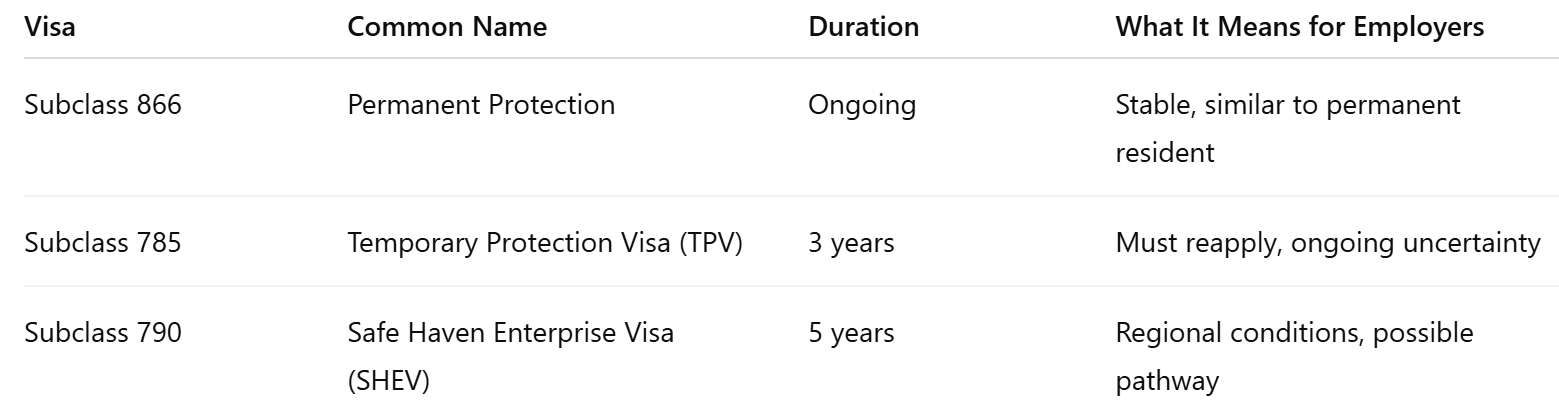
👉 Most people in recent years are on TPV or SHEV, not permanent visas.
This distinction matters more than anything else in this conversation.
Do They Have Work Rights?
In Most Cases: Yes
But it depends on the stage.
Bridging Visa (While Claim Is Being Processed)
Work rights may or may not be granted
Can change depending on circumstances
Granted Protection Visas
TPV and SHEV:
Full work rights
No employer restriction
Subclass 866:
Full work rights
Essentially treated like a permanent employee
👉 Always confirm through VEVO. Never assume.
Expiry and Stability (This Is Where Employers Get Caught)
Subclass 866 (Permanent)
Ongoing visa
Stable workforce option
TPV (785)
Valid for 3 years
Must reapply again and again
Outcome is never guaranteed
SHEV (790)
Valid for 5 years
Has specific conditions tied to regional work
👉 From a workforce planning perspective:
866 = low risk
SHEV = medium, conditional opportunity
TPV = high uncertainty
The SHEV Angle (Highly Relevant for Regional Employers)
This is the part most employers miss.
SHEV holders are expected to:
Live, work, or study in regional Australia
Spend most of their time in designated areas
Why This Matters to You
There is a natural alignment here:
You need workers in regional areas
They may need regional employment to meet visa conditions
The Opportunity
In general terms, if certain requirements are met over time, a SHEV holder may be able to access other visa pathways without the usual barriers applying.
👉 This is one of the few situations where a protection visa can realistically connect into a skilled pathway.
Can You Sponsor Someone on a Protection Visa?
The Honest Answer: Sometimes, but it is not simple
Here are the practical barriers employers run into:
1. Section 48 of the Migration Act
Under Migration Act 1958, Section 48 can prevent someone from applying for most visas while in Australia if they have had a visa refused.
What This Means for You
Even if:
You want to sponsor them
They are a good candidate
They may not be able to apply onshore.
👉 This can force:
Offshore applications
Gaps in employment
Uncertainty in timing
Does Moving to Another Visa Raise Questions?
Yes, it can.
From a decision-maker's perspective, they may look at:
Whether the original protection claim was genuine
Whether circumstances have changed
Whether actions contradict the claim
This is particularly sensitive if the person:
Travels back to their home country
Seeks documents from that country
👉 This can impact both the original protection claim and future visa options.
Travel Risk (This One Catches People Out)
If a protection visa holder travels back to the country they claimed protection from:
It can be used as evidence their claim is not genuine
It may affect future applications
It can even lead to visa issues
👉 For employers:
Do not assume travel is harmless. It needs proper advice before it happens.
Family Situation (Often Overlooked but Important)
Subclass 866
Can include family
Can sponsor family later
TPV and SHEV
Cannot sponsor family to come to Australia
Why This Matters for Employers
Long-term separation affects wellbeing
Impacts retention decisions
Influences willingness to stay regional
No Automatic Pathway to Permanence (For Many)
TPV Holders
No direct pathway to permanent protection
Must keep reapplying
SHEV Holders
May access other visa pathways if conditions are met
👉 From a business perspective:
If you want long-term stability, you need to start planning early.
Tribunal and Review Reality
Not all protection visa applicants are treated the same.
Two Different Review Pathways
Standard applicants: review through tribunal system
Fast track applicants: limited review through a different process
Practical Impact
Some cases allow full review and new evidence
Others are more restricted
👉 This affects:
How long uncertainty lasts
How much chance there is to fix issues
Why Protection Claims Get Refused
Understanding this helps you assess risk.
Common reasons include:
Inconsistent information
Lack of evidence
Changed circumstances
Not meeting the legal definition
The legal test sits under Section 36 of the Migration Act and includes both refugee protection and complementary protection considerations.
Employment Law Still Applies (No Exceptions)
Regardless of visa type:
Minimum wage applies
Superannuation applies
Fair Work obligations apply
👉 Visa status does not reduce employer obligations.
Sponsorship Costs and Commitments (Quick Reality Check)
If you are thinking about sponsorship:
You need to become a sponsor
There are government fees
There are training levy obligations
Labour Market Testing may be required
We break this down further here:
https://auvisas.au/post/becoming-a-business-sponsor
Workforce Planning Tip (This Is the Big One)
If your worker is on a TPV:
Do not wait until expiry
Start planning 12 to 18 months out
If they are on a SHEV:
Look at how their regional work aligns with future options
👉 The earlier you plan, the more options you have.
Key Legislation (For Reference)
Migration Act 1958 https://www.legislation.gov.au/C1958A00062/latest/text Sections 36, 48, 501.
Migration Regulations 1994 https://www.legislation.gov.au/F1996B03551/latest/text Part 4.
1951 Refugee Convention https://www.unhcr.org/about-unhcr/overview/1951-refugee-convention
1967 Protocol Relating to the Status of Refugees https://www.ohchr.org/en/instruments-mechanisms/instruments/protocol-relating-status-refugees
These set out:
Protection obligations
Visa framework
Legal definitions and thresholds
Practical Employer Takeaways
If you have someone on a protection visa:
Check work rights every time through VEVO
Understand which visa they actually hold (this is critical)
Do not assume long-term stability
Be careful building your business around uncertain status
Speak to a qualified professional early if sponsorship is being considered
Hypothetical Example (Employer Lens)
A regional manufacturing business hires a worker on a TPV.
He is skilled and reliable
The business wants to sponsor him
Reality:
He must reapply every 3 years
He may be subject to Section 48
Sponsorship may require leaving Australia
👉 Commercial takeaway:
This is not just a hire. It is a moving piece in your workforce strategy.
Glossary of Key Terms
TPV (Temporary Protection Visa)
A 3-year visa requiring ongoing reapplication.
SHEV (Safe Haven Enterprise Visa)
A 5-year visa with regional work conditions.
Subclass 866
Permanent protection visa.
Section 48 Bar
Restriction on applying for visas onshore after refusal.
VEVO
System to check visa conditions and work rights.
Related Articles
Related Articles that you may enjoy
https://auvisas.au/post/becoming-a-business-sponsor
https://auvisas.au/post/common-visa-mistakes
https://auvisas.au/post/labour-market-testing
https://auvisas.au/post/costperday
Source: AU Visas Employer Guide Series
Mandatory Disclaimer
The content provided is for informational purposes only and does not constitute immigration or legal advice. It is subject to change. Consult a MARA-registered migration agent or lawyer for professional advice before making any application.
👉 Contact AU Visas today for a professional opinion on your situation.


