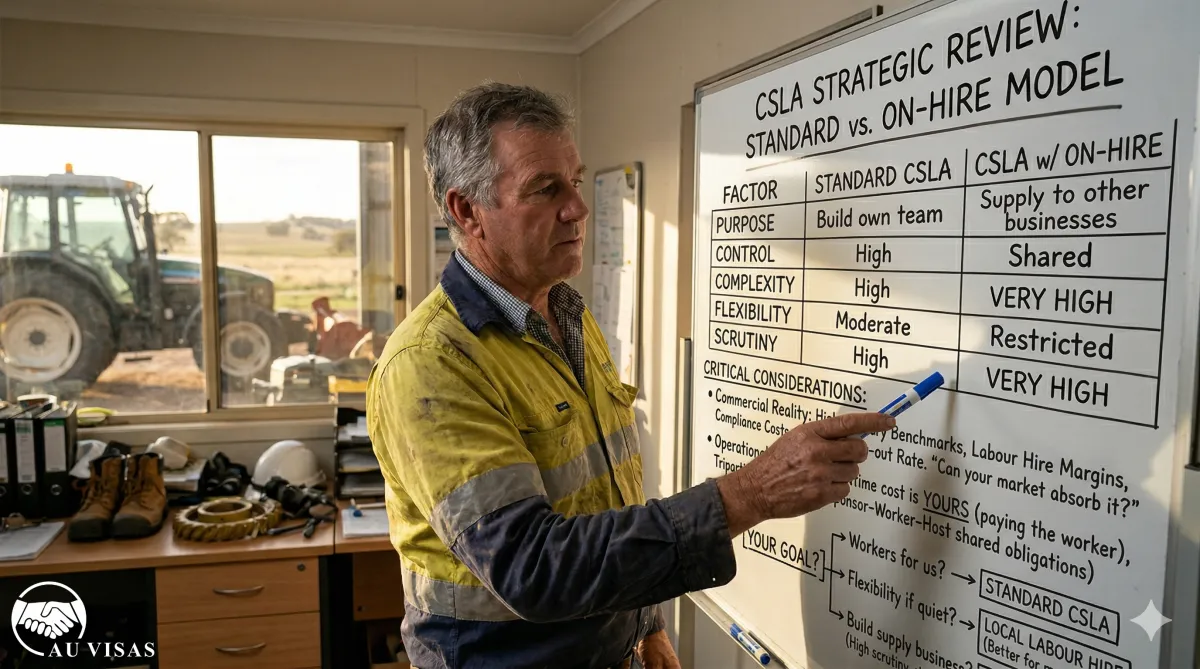
On-Hire Labour Agreements: Should You Build One Into Your CSLA?
If you are looking at a Company Specific Labour Agreement (CSLA), you are already thinking ahead.
This is not about filling one role.
This is about:
Securing workforce
Scaling production
Creating stability in a tight labour market
And somewhere along the way, this question comes up:
“Should we include an on-hire component?”
On paper, it sounds smart.
Bring workers in.
Use them internally.
Send them out when things slow down.
But in practice, this is where a lot of businesses get caught.
From my background in fabrication and bringing workers in myself, I can tell you — this is not just a visa decision.
👉 It is a business model decision.
Let’s break it down properly.
What Is an On-Hire Labour Agreement (in a CSLA Context)?
When you include on-hire in a labour agreement, you are asking for permission to:
Sponsor overseas workers
And place them into other businesses
That means you are no longer just:
👉 A business solving your own labour shortage
You are becoming:
👉 A labour hire provider operating inside the migration system
The Key Difference: CSLA vs CSLA with On-Hire
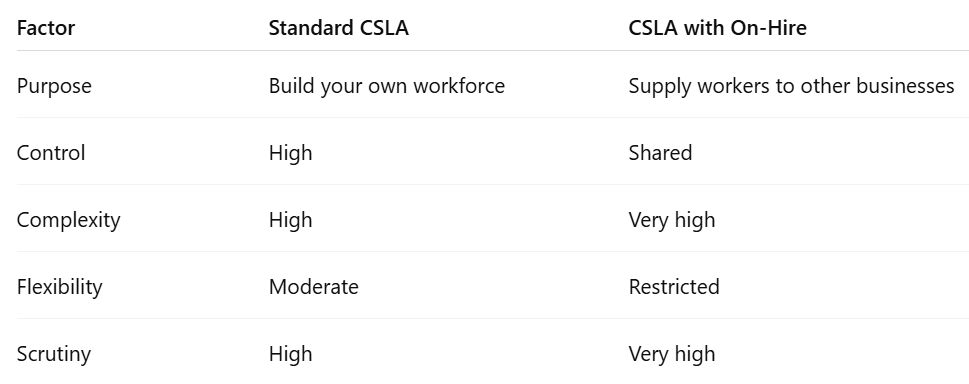
👉 This is not a small add-on.
It is a structural shift in how your business operates.
Why Don’t All Labour Agreements Include On-Hire?
Because on-hire is treated differently by the government.
There are real concerns around:
Worker protection
Wage consistency
Accountability across multiple sites
As a result:
👉 On-hire is not automatically approved
👉 And it is assessed much more strictly
The Big Constraint: Concessions Are Limited
This is one of the biggest practical differences.
Under a standard CSLA, in some cases, there may be room to discuss:
Experience levels
Occupation scope
Certain conditions (within limits)
With on-hire:
👉 That flexibility is often reduced
Why?
Because:
The government wants to avoid undercutting local labour
On-hire arrangements are seen as higher risk
So expectations are tighter.
Salary Expectations: Where It Often Breaks
This is the commercial reality most people miss.
With on-hire:
You are generally expected to meet strong market salary benchmarks
There is less room to structure roles creatively
You need to clearly demonstrate fair and consistent pay
Then you add:
Your labour hire margin
Compliance costs
Downtime risk
👉 The final charge-out rate increases quickly
The Commercial Question You Must Answer
Before you even consider on-hire:
👉 Can your market absorb your charge-out rate?
Because your client is comparing:
Your rate
vsLocal labour
vsOther contractors
If your rate is too high:
👉 The model breaks, regardless of visa approval.
What Industries Use On-Hire Models Most?
Typically:
Meat processing
Food production
Agriculture
Warehousing and logistics
Cleaning and facility services
Some manufacturing environments
Why these industries?
They have:
High labour demand
Repeatable skill sets
Multi-site deployment opportunities
What Roles Are Most Commonly On-Hired?
Most commonly:
Welders and fabricators
Machine operators
Process workers
Skilled labourers
These roles are:
In shortage
Easier to standardise
More commercially viable for labour hire
What Has Been Tried (and Tightened or Phased Out)?
There have been on-hire style arrangements in industries like:
Cleaning
Security
that were tightened significantly following compliance concerns.
👉 This is why approvals today are more controlled.
Can You Use On-Hire Workers in Your Own Business?
Yes - but within limits.
Workers must:
👉 Perform the nominated occupation
You cannot:
Move them into unrelated duties
Use them as general labour
Shift them freely across roles
What Happens When Work Slows Down?
This is the real pressure point.
You are still responsible for:
Paying the worker
Maintaining conditions
Keeping them compliant
If you cannot deploy them:
👉 The cost sits with you
This is where:
Margins get squeezed
Cashflow becomes critical
The Tripartite Risk (Important)
There are three parties involved:
You (sponsor and employer)
The worker
The host business
Even when placed externally:
👉 You still carry obligations
And the host business:
Still carries workplace responsibilities
This creates shared risk.
Can a Whole Business Be Built on On-Hire?
It can be done.
But:
👉 It will attract scrutiny
Government expectation is:
On-hire supports labour shortages
It does not replace a genuine local workforce
A balanced workforce is generally expected.
Can On-Hire Workers Lead to Permanent Residency?
This is where things get very practical.
In most cases:
👉 Workers will need to transition to direct employment
👉 And then be sponsored under a standard pathway
On-hire structures are not typically where long-term pathways are built.
The Contract Reality (Often Overlooked)
Here is what many employers discover too late.
When you supply a worker to a client:
👉 There is often a commercial agreement in place
This may include:
Restrictions on direct hiring
Transfer fees or cost recovery
Notice periods
This protects:
👉 The upfront investment made by the labour hire provider
But it also means:
👉 Moving a worker into direct employment can be more complex
From the worker’s perspective:
It can slow down progression
It can limit flexibility
From the employer’s perspective:
You need to plan this upfront
What About Age Limits?
In general:
Temporary pathways are more flexible
Permanent pathways introduce practical limits
Some labour agreements:
May include age concessions
But:
👉 On-hire does not automatically create a workaround
Is On-Hire a Shortcut Around Sponsorship?
Short answer:
👉 No
If anything:
It is more complex
More regulated
More commercially demanding
Would It Be Better to On-Hire Local Workers Instead?
For many businesses:
👉 Yes, in certain situations
If your goal is:
Flexibility during quiet periods
Managing short-term demand
Using local labour hire:
Avoids migration complexity
Reduces compliance exposure
Maintains flexibility
CSLA vs On-Hire Strategy — A Clear Comparison
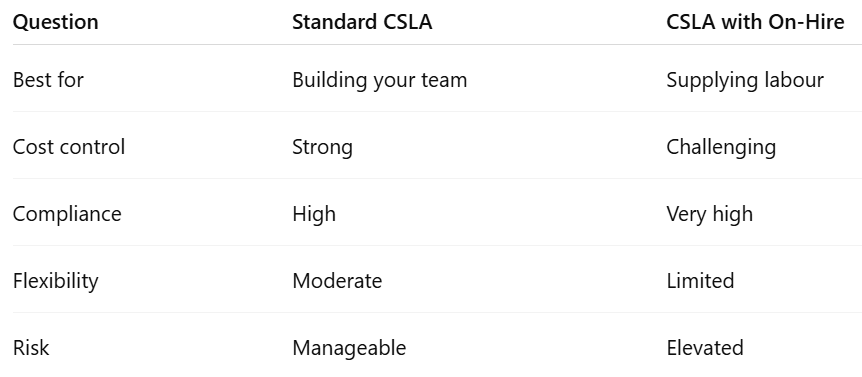
Decision Framework (Straight Answer)
If your thinking is:
“We need workers for our own business”
→ Focus on standard CSLA or sponsorship
“We want to build a labour supply business”
→ Then consider on-hire, but go in with full understanding
If your thinking is:
“We want flexibility if things go quiet”
→ Consider local labour hire instead
Final Thought
On-hire is often seen as flexibility.
In reality:
👉 It is a different business model entirely
It comes with:
Higher cost pressure
Higher scrutiny
Higher operational risk
For most regional businesses:
👉 Building your own workforce is the stronger, more stable play
Glossary of Key Terms
CSLA
Company Specific Labour Agreement tailored to a business.
OHLA
On-Hire Labour Agreement allowing workers to be placed with other businesses.
ANZSCO
Occupation classification system.
Nomination
Linking a worker to a role.
PR
Permanent residency.
LMT
Labour Market Testing.
Related Articles (Internal Linking)
Related Articles that you may enjoy
https://auvisas.au/post/becoming-a-business-sponsor
https://auvisas.au/post/common-visa-mistakes
https://auvisas.au/post/labour-market-testing
https://auvisas.au/post/costperday
Source: AU Visas Employer Guide Series
Mandatory Disclaimer
The content provided is for informational purposes only and does not constitute immigration or legal advice. It is subject to change. Consult a MARA-registered migration agent or lawyer for professional advice before making any application.
👉 Contact AU Visas today for a professional opinion on your situation. https://auvisas.au/free-consult for businesses.


