How to Assess If Your Business Qualifies for Sponsorship
If you’re at the beginning of the sponsorship journey, the first question is usually:
“Can we even do this?”
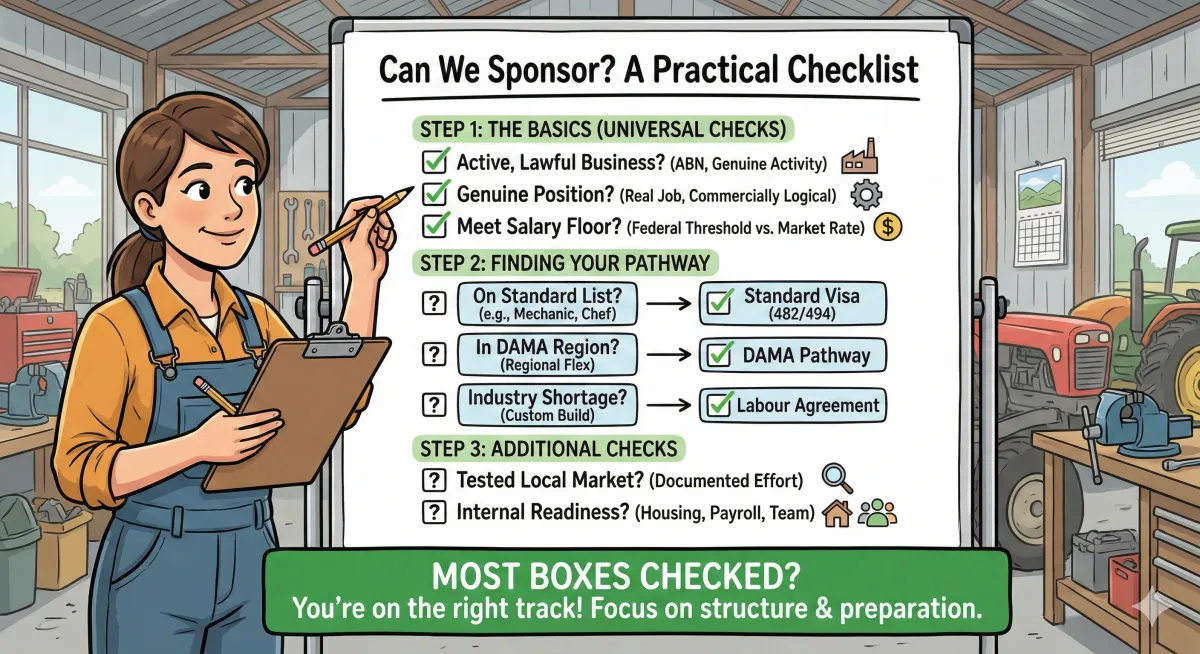
Before diving into visa subclasses or government terminology, think of sponsorship like building approval.
There are:
Foundations - every business must meet them.
Pathways - which depend on your industry, region, and workforce need.
From my background in fabrication and hiring in regional NSW, I’ve seen this first-hand: sponsorship isn’t reserved for big city corporates. Many successful sponsors are small manufacturers, farms, hospitality venues and workshops - provided the groundwork is solid.
Let’s walk through it the way a practical regional operator would.
Step 1: The Universal Questions
These apply to every business, in every industry.
If you can tick these boxes, the door is open.
1️⃣ Is Your Business Active and Lawfully Operating?
To qualify as a sponsor, your business must:
Have an active ABN
Be legally operating
Show genuine commercial activity
That can include BAS statements, financial records, contracts, payroll data, or evidence of trading.
Hypothetical Scenario
You run a fabrication workshop and recently moved from sole trader to Pty Ltd. New company. New ABN.
The catch:
Sponsorship approvals are tied to the legal entity. A previous approval under your old ABN does not automatically transfer.
Lesson: Structure matters. Sponsorship attaches to the company, not the individual owner.
2️⃣ Is the Position Genuine?
The question isn’t whether the worker is good.
It’s whether the role makes commercial sense.
Decision-makers assess:
Does the role align with your business activity?
Would additional Staff open up additional revenue?
Is it consistent with your size and revenue?
Would you employ someone in this role regardless of who they are?
Hypothetical Scenario
A small café with three staff tries to sponsor a “Corporate Marketing Director.”
That raises red flags.
But the same café sponsoring a qualified Chef because the owner is working 80 hours per week in the kitchen?
That’s commercially logical.
Lesson: The role must match the scale and reality of your business.
3️⃣ Can You Meet the Salary Floor?
You must pay:
The Temporary Skilled Migration Income Threshold (TSMIT) — currently $73,150 (plus super), OR
The Annual Market Salary Rate (AMSR)
Whichever is higher.
You can’t offset it with future bonuses or vague commission promises.
Hypothetical Scenario
You pay Agricultural Technicians $70,000.
Even if that’s your established local rate, sponsorship requires meeting the federal threshold.
Lesson: Budget for the national floor early. If the numbers don’t stack up, reassess before proceeding.
4️⃣ Can You Demonstrate Financial Capacity?
You don’t need to be a $20 million business.
But you must show:
You can sustain the wage
You can pay super
You can maintain employment over the visa period
The focus is on sustainability.
Hypothetical Scenario
A seasonal horticulture business has strong annual revenue but uneven monthly cashflow.
The question becomes:
Can you demonstrate year-round employment continuity?
Lesson: Sponsorship is about stability, not just turnover.
Step 2: Finding Your Pathway
Once foundations are solid, the next question is:
What pathway fits your occupation and region?
Pathway A: Standard Occupation Lists
Many trades and professions are included, such as:
Mechanics
Welders
Chefs
Engineers
Nurses
Agronomists
Common employer pathways include:
For regional employers, the 494 often aligns well with long-term retention planning.
Pathway B: DAMA (Regional Flexibility)
If your occupation isn’t on the main list, don’t assume it’s over.
Some regions operate under a Designated Area Migration Agreement (DAMA).
DAMAs can allow:
Additional occupations
Age concessions
In certain cases, salary flexibility
Hypothetical Scenario
You run a regional logistics business. Truck Drivers aren’t on the standard list.
Your region’s DAMA includes them.
Suddenly, sponsorship becomes possible.
Lesson: Regional location can be an advantage, not a limitation.
Pathway C: Company Labour Agreement (Custom Build)
If your industry has structural shortages not covered by standard lists or DAMA, a Company-Specific Labour Agreement may be considered.
Typically relevant for:
Large-scale agricultural processors
Poultry operations
Meat processing plants
Niche manufacturing sectors
Hypothetical Scenario
You operate a poultry processing facility. The occupation isn’t available on standard pathways.
Through a negotiated Labour Agreement, the Government recognises the ongoing shortage and sets tailored conditions.
Important reality:
Labour Agreements require strong evidence of local recruitment efforts and genuine industry need. They are structured solutions, not shortcuts.
Step 3: The Local First Requirement (Labour Market Testing)
In most cases, you must demonstrate attempts to recruit locally.
This usually involves:
Advertising on approved platforms
Running ads for at least 28 days
Including the salary range
Keeping recruitment records
Hypothetical Scenario
You post a 10-day Facebook ad.
That won’t satisfy requirements.
But:
You run compliant ads on Seek and Workforce Australia for 28 days, list the salary, and document why applicants lacked required skills.
That becomes strong supporting evidence.
Lesson: Keep a recruitment diary. It’s one of your strongest assets.
Step 4: Regional (494) Nuances
For regional businesses, the 494 pathway includes additional elements:
Endorsement from a Regional Certifying Body (RCB)
The worker must live and work in designated regional areas
Permanent residence (subclass 191) later requires meeting income thresholds over time
This isn’t just hiring for today — it’s workforce planning over several years.
If retention matters, understanding these settings early avoids surprises later.
Step 5: Internal Readiness
Eligibility is one thing. Operational readiness is another.
Ask yourself:
Housing
Is there accommodation available locally?
Payroll
Is payroll prepared for reporting and compliance?
Leadership Alignment
Is your management team fully on board?
Duration
Can you sustain this role for 2–4+ years?
Many sponsorships succeed legally but struggle operationally.
Planning early makes a significant difference.
A Simple Self-Assessment Checklist
Before you move further, ask:
✅ Is our ABN active and are we genuinely trading?
✅ Is the role commercially logical for our size?
✅ Can we meet the federal salary threshold?
✅ Can we demonstrate financial stability?
✅ Is the occupation on a standard list, DAMA, or suited to a Labour Agreement?
✅ Have we properly tested the local market?
✅ Are we operationally ready (housing, onboarding, payroll)?
If you can answer “yes” to most of these, you’re starting from informed ground.
Final Thought
Many regional employers assume sponsorship is for:
Big corporations
City firms
Multinationals
In reality, many successful sponsors are:
Family farms
Regional workshops
Local manufacturers
Independent hospitality venues
Qualification isn’t about size.
It’s about structure, sustainability, and preparation.
If you have a genuine skill gap and a stable business, there is usually a lawful pathway available. The key is understanding which map applies to your postcode and industry.
Glossary of Key Terms
ABN – Australian Business Number. Identifies your legal business entity.
SBS – Standard Business Sponsorship approval.
TSMIT – Temporary Skilled Migration Income Threshold (minimum salary floor).
AMSR – Annual Market Salary Rate.
DAMA – Designated Area Migration Agreement for regional areas.
Labour Agreement – A negotiated agreement between a business and the Government allowing sponsorship under tailored conditions.
RCB – Regional Certifying Body (assesses regional nominations).
494 Visa – Regional employer-sponsored provisional visa.
482 Visa – Skills in Demand employer-sponsored temporary visa.
LMT – Labour Market Testing (local recruitment evidence).
Related Articles
Related Articles that you may enjoy
https://auvisas.au/post/becoming-a-business-sponsor
https://auvisas.au/post/common-visa-mistakes
https://auvisas.au/post/labour-market-testing
https://auvisas.au/post/costperday
Source: AU Visas Employer Guide Series
Mandatory Disclaimer
The content provided is for informational purposes only and does not constitute immigration or legal advice. It is subject to change. Consult a MARA-registered migration agent or lawyer for professional advice before making any application.
👉 Contact AU Visas today for a professional opinion on your situation. https://auvisas.au/free-consult for business.


