
How to Tell If a Skilled Visa Candidate Is Actually Eligible
Selecting an overseas worker is a recruitment decision. Sponsoring one is something more.
Before a regional employer commits time and money to a candidate, there is a separate question that needs answering.
Not “can this person do the job” - but “can this person actually be approved for an employer-sponsored visa.”
These are two different tests. A candidate can be excellent in the workshop, kitchen, or office, and still be the wrong person to put through a sponsorship pathway. The difference is rarely about skill. It is almost always about eligibility, evidence, and history.
This guide is about that second test.
It is written for Australian employers, internal recruiters, overseas placement agents, and the candidates themselves. It focuses on the candidate side of the equation — the things the applicant must satisfy and prove before any visa pathway makes sense. It does not cover the employer-side activities like labour market testing, becoming a sponsor, or nomination. Those are separate articles in this series.
The information here reflects the rules as we understand them in 2026, including the Skills in Demand (SID) framework introduced in late 2024, the English language changes from 13 September 2025, and the income threshold increases scheduled for 1 July 2026. Migration policy moves quickly. Always confirm settings with a MARA-registered migration agent or qualified Australian lawyer before relying on anything below for a real application.
Why Candidate Eligibility Is Its Own Discipline
Most recruitment processes ask three things: can this person do the work, will they fit the team, and are they serious about relocating. All of that matters. But for sponsored migration, there is a fourth question that sits underneath all of them.
Can this candidate actually be approved?
That question turns on a series of separate tests:
Are they the right age for the visa?
Do they have the required years of experience?
Does that experience match a real occupation on the relevant list?
Can they prove the experience with multiple types of evidence?
Do they have the required qualifications?
Can they pass the English requirement?
Do they need a skills assessment, and can they pass it?
Will they meet the health requirement?
Will they meet the character requirement?
Have they had any past visa refusals, cancellations, or fraud findings?
Is their identity consistent across all their documents?
If onshore, what visa do they currently hold and what conditions apply?
Are their family members eligible too?
A weak answer to any one of these can be fatal to the file. A weak answer to several is a clear sign to stop, not to push harder.
The job of the screening employer or agent is not to make a final legal decision. It is to identify these issues early — before a candidate becomes a sunk cost.
The Two-Part Test: Job-Ready and Visa-Ready
A strong candidate has to clear both gates.
Job-ready means they can do the work to the standard your business needs — skill, attitude, communication, safety awareness, reliability.
Visa-ready means their personal history, documents, qualifications, and circumstances line up with the legal criteria of a real visa pathway.
It is common to find a candidate who is strong on one side and weak on the other. The classic examples:
A 47-year-old diesel mechanic with 25 years of fleet experience who would be an excellent hire, but who falls outside the age cap for the 494 visa.
A 28-year-old hospitality worker with two months of cooking experience who is keen and easy to train, but cannot satisfy the 12-month occupation experience minimum for the 482 SID.
A skilled tradesperson whose work history is real but whose previous employer paid in cash, leaving no payslips, tax records, or bank deposits to prove it.
A talented professional with strong English in conversation, but who has never sat a formal English test and will need three to six months to prepare and pass one.
None of these candidates are “bad.” They are simply not yet ready, or not the right fit, for the visa pathway being considered. Screening identifies that before commitment.
The Main Employer-Sponsored Visa Pathways at a Glance
The candidate requirements differ depending on which visa pathway is being considered. The most common employer-sponsored options in 2026 are summarised below.
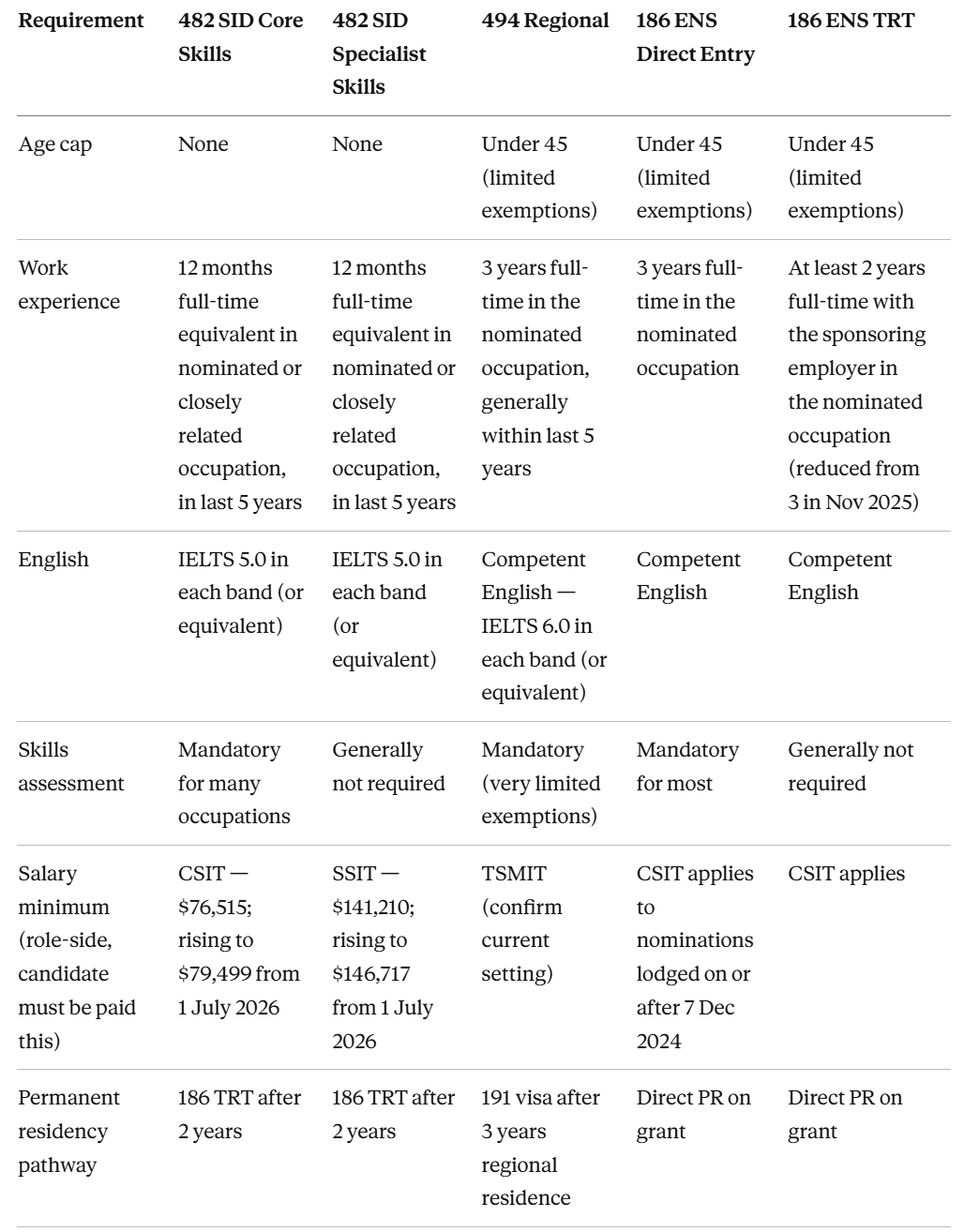
A few important notes on the table:
Age exemptions for the 494 and 186 exist but are narrow. They include certain academic, scientific, medical and high-income categories, and some 482-to-186 TRT transitions.
The 12-month and 3-year experience figures refer to the nominated occupation or a closely related field, not to the candidate’s general working life.
The 482 SID and 186 ENS now both reference the Core Skills Occupation List (CSOL) for occupation eligibility. The 494 occupation settings have been in transition — confirm the current list at the point of lodgement.
The salary threshold is the employer’s obligation, not the candidate’s. But if the role does not meet it, the candidate is not viable for that pathway. Worth checking before screening goes deeper.
DAMA (Designated Area Migration Agreement) pathways exist for certain regions and can provide concessions on age (often up to 50, sometimes 55), English, work experience, salary, and occupation. If the standard pathways don’t fit, a DAMA may.
Age Requirements
Age operates differently depending on the visa.
No upper age limit applies to the 482 SID itself. A 52-year-old chef with strong experience, English, and documents can be a viable 482 candidate.
The 45-year cap applies to the 494 and 186 visas at the time of application. A few categories of exemption exist — for example, certain medical practitioners, academics, and scientific researchers, high-income earners in some structures, and 482-to-186 TRT transitions in specific circumstances — but the cap is otherwise strictly enforced.
DAMA concessions may extend the age limit to 50 or 55 depending on the agreement and occupation. This matters because a candidate who would be rejected on age under a standard 494 might be eligible under a DAMA in the same region.
For employers, the practical rule is simple. Collect the date of birth at the screening stage. If the candidate is over 45 and the obvious pathway is a 494 or 186, pause and get migration input before going further. If the candidate is in their early forties, plan the pathway carefully so that any 186 step happens before the 45th birthday.
For overseas agents: please do not put 47-year-old candidates forward for 494 sponsorship without first confirming a DAMA or exemption is genuinely available. It is one of the most common time-wasting referrals.
Work Experience Requirements
The headline numbers:
482 SID (both Core Skills and Specialist Skills): at least 12 months full-time equivalent experience in the nominated occupation or a closely related field, gained in the last 5 years. Part-time and casual work can count if it adds up to 12 months full-time equivalent. The 12 months does not have to be continuous.
494: at least 3 years full-time in the nominated occupation, generally within the last 5 years. Casual work is generally not accepted.
186 Direct Entry: at least 3 years of relevant work experience, typically post-qualification.
186 TRT: at least 2 years full-time with the sponsoring employer in the nominated occupation (reduced from 3 years in November 2025).
The legal phrase that matters is “in the nominated occupation or closely related field, at the required skill level.” Three years sweeping a workshop is not three years as a diesel mechanic. Five years as a kitchen hand is not five years as a cook.
This is why a resume alone is not enough. The duties, hours, tools, processes, and responsibilities have to be evidenced — not just claimed.
Multiple Proofs of Work Experience
A single reference letter is not a work history file. It is one document. For visa screening, the stronger approach is to build a layered evidence trail that proves the candidate not only held the job title, but actually performed work matching the nominated occupation.
The aim is to be able to answer this question with confidence: if an independent assessor compared this file against the duties of the nominated occupation, would they agree?
A strong work experience file usually includes:
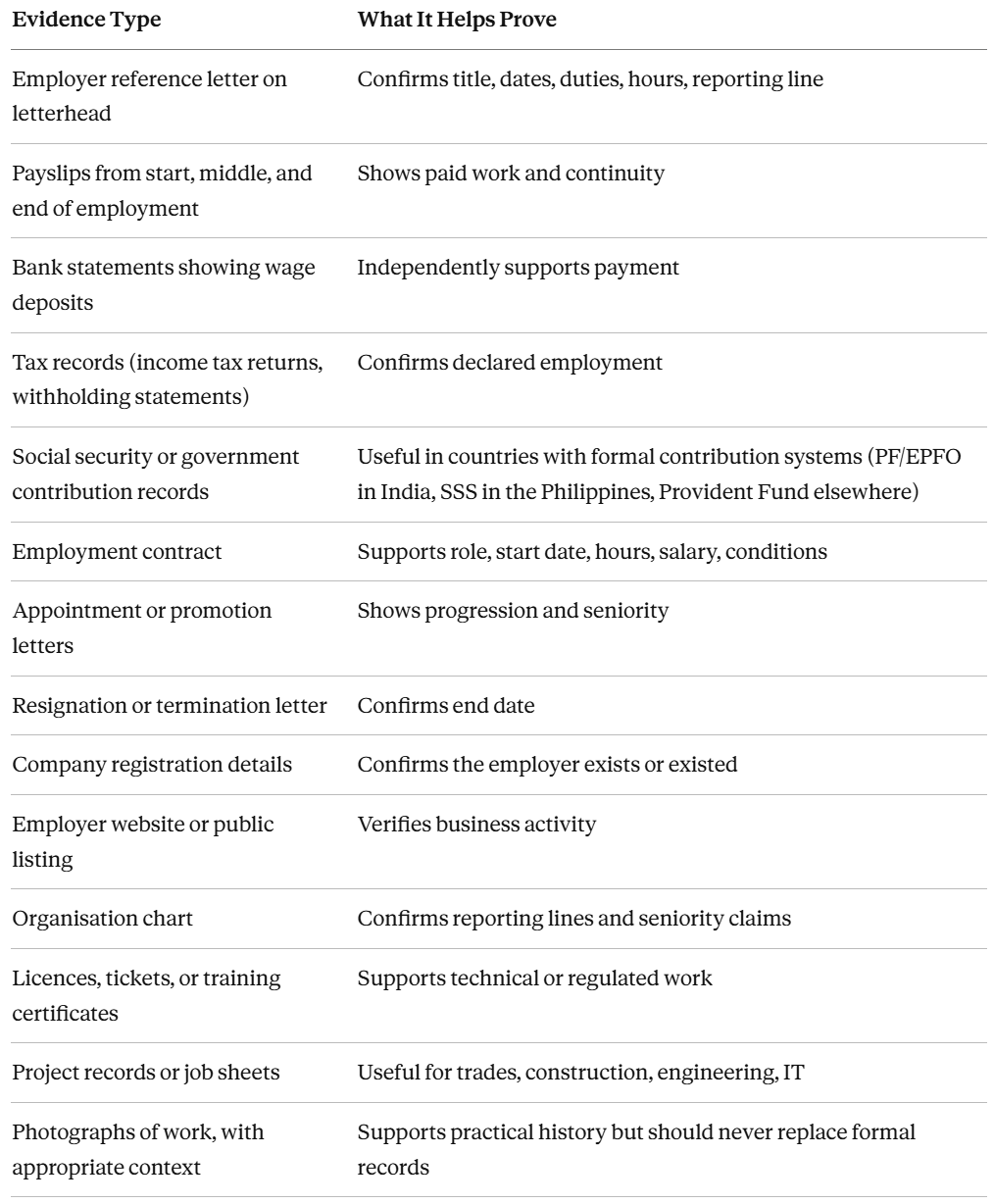
The strongest files draw on evidence from different angles. A diesel mechanic claiming six years at one transport company is far more credible when their file contains:
A detailed letter from the employer
Payslips from the beginning, middle, and end of employment
Bank deposits matching those payslips
Tax records covering the period
Training certificates from across the six years
A clear written description of the fleet, tools, repair work, and supervisory responsibilities
A reachable referee who confirms the story on a phone call
One document can be wrong, vague, exaggerated, or hard to verify. Several documents covering the same ground create a picture that is much harder to dispute.
This becomes especially important where the candidate has worked in small businesses, family businesses, cash-heavy industries, countries with different record systems, or roles where job titles do not clearly describe the actual work performed.
The practical rule for employers and agents: do not rely on one reference letter if the role is important. Build a work history evidence trail before you commit to the candidate.
Occupation Fit — Matching the Candidate to an ANZSCO Code, Not Just a Job Title
This is one of the highest-cost screening failures in the industry.
The Department of Home Affairs assesses skilled visa applications against occupations described by ANZSCO codes. Each code has specific duties, skills, qualifications, and skill levels attached. A “mechanic” on a resume could match any of several different ANZSCO codes — and the wrong code can refuse the file.
Some common splits where employers and agents trip:
Motor Mechanic (General) 321211 vs Diesel Motor Mechanic 321212 vs Mobile Plant Mechanic 321213 vs Small Engine Mechanic 321214 — the duties and equipment matter, not just the job title “mechanic”.
Cook 351411 vs Chef 351311 — the chef role requires more menu development, kitchen leadership, and culinary qualifications. Hospitality nominations may be refused because a “chef” candidate has actually been doing cook duties.
Fabricator roles spread across welding, structural steel work, sheet metal, and boilermaking — each with different ANZSCO codes.
Manager titles are heavily scrutinised. The candidate must have actually supervised staff, held budget responsibility, and made operational decisions. An inflated “manager” title with no real management content is one of the most common refusal patterns.
For screening, the question to ask is not “does this candidate sound like a manager” but “does the candidate’s actual day-to-day work line up with the ANZSCO duties of the nominated occupation.”
Some CSOL occupations also carry caveats — additional conditions about the type of business, minimum turnover, industry, or duties. A position that looks eligible at first can fall over a caveat. Always have a MARA agent confirm caveats before progressing a candidate.
Qualifications
Qualifications can come from many sources: Australian institutions, overseas universities, overseas trade certificates, TAFE-style courses delivered offshore, apprenticeships, short courses, industry tickets, or recognition of prior learning. Not all of them are treated equally for migration purposes.
For screening, the employer or agent does not need to make the legal decision about whether a qualification is acceptable. The job is to collect the documents in good condition, early.
For each qualification, ask for:
The certificate or award document
The full academic transcript
A completion letter if available
The name and address of the institution
The course duration and mode of study
Apprenticeship records or trade training records
Licensing or registration documents in the home country
Certified English translations where the documents are not in English
For trades and some other occupations, qualifications alone may not be enough — a formal skills assessment is required (see next section).
Skills Assessment
A skills assessment is a formal evaluation by an Australian-approved assessing authority confirming that the candidate’s qualifications and experience meet the required standard for the nominated occupation. Some occupations require it. Others do not. The requirement depends on the visa, the stream, and the specific occupation.
The hard rule: where a skills assessment is mandatory, it generally must be commenced or completed before the visa application is lodged. Lodging without it can render the application invalid, not merely refused.
Common assessing authorities and indicative timelines:
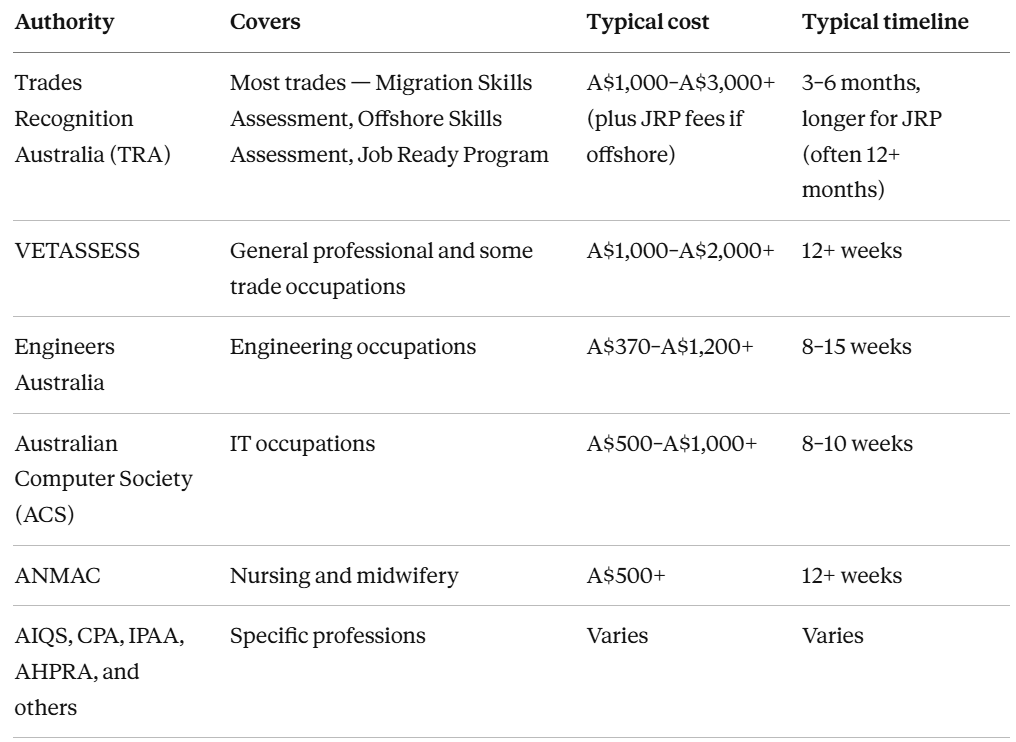
For screening, the questions to ask the candidate early are:
Have you completed a skills assessment? If so, for what occupation, by which authority, and on what date?
Is it still current?
Does it match the occupation we are considering?
Were any conditions attached?
A current, positive, matching skills assessment is one of the most valuable things a candidate can already have. It removes months of cost and risk from the timeline.
A candidate without a skills assessment for a trade occupation should be told plainly: this is the longest step in your pathway. Plan accordingly.
English Language Requirements
English requirements were updated by Legislative Instrument LIN 25/082, effective for tests taken on or after 13 September 2025. The current settings:
For the 482 SID visa, the primary applicant must demonstrate vocational-level English unless an exemption applies. For tests taken on or after 13 September 2025:
IELTS: 5.0 in each of the four bands (Listening, Reading, Writing, Speaking)
PTE Academic: Listening 33, Reading 36, Writing 29, Speaking 24
TOEFL iBT: equivalent component scores
OET: B in each of the four components
Cambridge English / LanguageCert / CELPIP: equivalent results
Test results must be no more than three years old at the time of application. Online or at-home tests are not accepted — tests must be sat at an approved in-person centre. For TOEFL iBT taken on or after 21 January 2026, applicants must select “Taking TOEFL for Australia” at registration.
For the 494 and 186 visas, the requirement is competent English — IELTS 6.0 in each band or equivalent. This is materially higher than the 482 standard.
Exemptions from the English test requirement include:
Passport holders from the United Kingdom, United States of America, Canada, New Zealand, and the Republic of Ireland — citizenship alone satisfies the requirement
Five or more years of full-time study at secondary level or above where most classes were conducted in English
High-income exemption — guaranteed annual earnings of at least A$96,400 for the 482 (confirm current setting)
Certain diplomatic and consular roles
Occupations where the candidate had to demonstrate equivalent English to obtain Australian licensing or registration
For screening, English is one of the most underestimated steps. A candidate who speaks well in a video call may still need several months to prepare for and pass a formal test at the required band. Treat the test, not the conversation, as the deciding factor.
Practical screening steps:
Ask if the candidate holds a passport from one of the five exempt countries.
Ask if they completed five years or more of English-medium study.
Ask if they have a current English test result. If yes, request a copy and check the date.
If no recent test exists, plan two to four months minimum for preparation and testing before lodgement.
Do a video interview to assess workplace communication separately. Test results and workplace communication are not the same thing.
Health Requirements (PIC 4005 and PIC 4007)
All visa applicants — and most family members included in the application — must meet Australia’s health requirement. This usually involves a medical examination by an approved panel doctor, including chest X-ray and blood tests where required.
The health requirement screens for two things:
Public health risks (notably active or latent tuberculosis)
Significant costs to Australia’s health and welfare systems, or use of services in short supply
Common screening points:
Tuberculosis — active or latent TB is identified in many candidates from high-prevalence regions (parts of South and Southeast Asia, the Pacific, Africa). Active TB usually requires treatment before grant. Latent TB may require monitoring undertakings.
HIV — not an automatic bar, but the projected cost of treatment is assessed.
Hepatitis B and C — manageable but require declaration.
Significant cost or care conditions in dependants — including children with disabilities or chronic conditions. The cost-of-care assessment applies to the whole family unit, not just the primary applicant.
Pregnancy — visa medicals during pregnancy are common but X-rays are usually deferred until after delivery, which can affect timelines.
For employer-sponsored visas, a health waiver is available where the cost or services threshold is exceeded but the case otherwise warrants approval. Waivers are not automatic and require careful submission.
For screening, ask the candidate directly and respectfully: are you aware of any health conditions in yourself or any family member you would include in the application that may need treatment, ongoing care, or specialist services in Australia? Disclosure now is far better than discovery at the medical stage.
Character Requirements (PIC 4001) and Police Clearances
All applicants must satisfy the character requirement. This involves police clearance certificates and a Department assessment of any criminal, security, or conduct history.
Police clearances are required from every country the applicant has lived in for 12 months or more in the past 10 years (counted cumulatively). For some applicants this means clearances from three or four countries.
Issues that can arise:
Past convictions — even minor or historical convictions may need to be disclosed. Failure to disclose is more dangerous than the conviction itself.
Substantial criminal record — a sentence of 12 months or more (or aggregated 12 months) can trigger the character test under section 501 of the Migration Act.
Pending charges — open matters need to be resolved or carefully managed.
Military service in conflict zones, association with proscribed organisations, or security concerns — may trigger extended security checks adding many months to processing.
Domestic violence history — increasingly considered in character assessments.
For screening, ask the candidate to provide a written summary of every country they have lived in for 12 months or more in the past 10 years. From that, work out which police clearances will be needed. Some countries (e.g., the US FBI clearance, UK ACRO) can take weeks; some (e.g., parts of Africa and South Asia) can take months. Plan accordingly.
PIC 4020 — The False Documents Trap
This is the single most important warning for anyone working with overseas candidates, foreign agents, or third-party employment letter providers.
Public Interest Criterion 4020 is triggered when an applicant provides a bogus document or false or misleading information in connection with the visa application (or during the previous 12 months). The consequences:
Refusal of the current application
A 3-year refusal bar on future applications in most visa classes
A 10-year bar where the bogus document or false information relates to identity
The bar can extend to family members in some structures
A bogus document is not only an outright forgery. It includes documents that are counterfeit, obtained fraudulently, altered, or that contain false information.
What this means in practice:
A polished but inaccurate employment reference letter from an obliging former colleague is a PIC 4020 risk.
A payslip that has been altered to show different hours or pay is a PIC 4020 risk.
An English test certificate purchased from an unauthorised vendor is a PIC 4020 risk and ends careers.
A skills assessment file padded with fabricated project descriptions is a PIC 4020 risk.
A foreign agent who “helps” a candidate by drafting employer letters the actual employer has not seen is creating PIC 4020 risk for the candidate.
The screening rule is hard and non-negotiable: every document submitted must be genuine, accurate, and verifiable. If a document cannot be verified by an independent source (employer phone call, tax authority record, bank statement, professional body register), it should not be in the file.
Foreign agents and recruiters who push candidates to “improve” documents should be removed from the process. They are not helping. They are setting the candidate up for a multi-year ban and the employer up for a refused nomination.
Identity and Name Consistency
Identity issues are common with overseas candidates and almost always solvable — but they need to be addressed early, not at lodgement.
Typical screening issues:
Single-name applicants (common in Indonesia, Burma, parts of South India): how the name will be entered into Australian systems needs to be decided and applied consistently across passport, qualifications, references, and visa application.
Patronymic naming systems (Iceland, parts of MENA, parts of Africa): the “surname” on the passport may be the father’s given name.
Name changes after marriage without formal name change documents: very common in parts of South Asia and Africa.
Transliteration variations: Cyrillic, Arabic, Chinese, Korean, Thai, and other scripts can be transliterated several ways. A candidate may appear as “Mohammad”, “Mohammed”, “Muhammad”, or “Mohamed” across different documents. Each variation can create matching problems.
Family name first vs given name first (e.g., Chinese, Vietnamese, Hungarian): order matters for visa databases.
Aadhaar, PAN, EPFO, and similar national IDs may not match passport spelling exactly.
For screening, request the passport first and lock in one consistent spelling and order for the entire file. Update or annotate other documents to match. Where a candidate cannot produce documents in a single consistent identity, slow down and get advice — this is a PIC 4020 risk area.
Current Visa Status (Onshore Candidates)
If the candidate is already in Australia, screening must include their current immigration status. This affects work rights, application timing, bridging visa entitlements, and sometimes whether they can lodge onshore at all.
Documents to collect:
Current visa grant notice
Current passport
Visa expiry date and conditions
VEVO check printout
Any bridging visa details
Previous visa history (refusals, cancellations)
Specific traps to watch for:
Section 48 bar: a candidate who has had a substantive visa refused or cancelled (outside narrow exceptions) generally cannot apply onshore for most visas, including the 482. They must depart and apply offshore. This is a frequent surprise.
Visa Condition 8503 (“No Further Stay”): present on some visitor visas. It bars further onshore applications unless waived.
Bridging visas: lodging a new application from a substantive visa typically activates a Bridging Visa A. Work rights on the BVA depend on the underlying visa and the new application. Lodging from a bridging visa is more complex.
Student visa to 482 transitions: workable but requires careful sequencing.
Working holiday (subclass 417/462) candidates: can be sponsored, but timing, age, and prior visa history all matter.
Previous refusals: even refusals years ago can affect current options. Always disclose and verify.
If the candidate is onshore and the visa picture is complex, do not commit to recruitment until a MARA agent has reviewed it.
Family Unit Considerations
The candidate is rarely a single person on paper. The visa application usually covers a family unit, and that family unit can change the timeline, cost, and risk profile of the file.
For screening, ask about:
Spouse or de facto partner — including evidence of relationship if not married. A de facto relationship usually requires 12 months of cohabitation evidence unless an exception applies.
Dependent children — under 18 are straightforward; 18-23 in full-time tertiary study can usually be included with dependency evidence; over 23 are generally not includable.
Stepchildren and adopted children — additional documentation required.
Children with health or care conditions — see the health section above.
Custody and shared parenting arrangements — written consent of the other parent may be needed for children moving to Australia.
Dependents not coming initially — can be added later as subsequent entrants, but planning helps.
Family-side issues can double or triple the document workload. Foreign agents should collect family details up front, not as an afterthought.
Country-Specific Document Notes for Foreign Agents
Different countries produce different evidence. The following is a high-level orientation — it is not a complete guide and each country has many further nuances.
Philippines PSA-authenticated birth, marriage, and CENOMAR documents are the standard. NBI clearance for character. SSS, Pag-IBIG, and PhilHealth contribution records are useful work evidence. Documents are generally well-formed but check for name spelling consistency across IDs.
India Form 16 (TDS certificate), Form 26AS, and Income Tax Returns are strong work evidence. EPFO/UAN service history is excellent for employment continuity. Watch for inflated experience letters, particularly from consultancy and BPO employers. Name variations (single name, expansion of initials, post-marriage changes) are common and need to be resolved early. PIC 4020 risk profile is higher in some segments — verify documents independently.
Pakistan, Bangladesh, Sri Lanka Variable formal employment records. Salary slips often informal — corroborate with bank statements and tax records where available. Police clearance processes can be slow.
Nepal Employment is frequently informal, especially in trades and hospitality. Expect heavy reliance on reference letters supported by bank deposits, where they exist. Document translation and notarisation will be needed.
Vietnam, Indonesia, Cambodia, Laos Formal tax records may be limited. Bank deposit history is often the strongest independent evidence. Translations and notarisations are usually required.
China Notarised translations are essential. Hukou registration, danwei records, and social insurance records can be useful. Document verification can be more difficult — allow time.
Africa (multiple countries) Highly variable. Document availability and authenticity vary by country. Police clearance and qualification verification can take months. PIC 4020 risk profile is higher in some segments — independent verification is essential.
United Kingdom, Ireland, Canada, New Zealand, United States, South Africa, Zimbabwe Strong formal records. P60s, W-2s, T4s, and equivalent statements are gold-standard work evidence. Passport-based English exemption applies for UK, Ireland, Canada, NZ, and US.
Middle East (UAE, Saudi Arabia, Qatar, Oman, Kuwait, Bahrain) For non-citizens working in these countries, work permits and labour contracts are useful evidence alongside payslips and bank transfers. Many candidates in this region are third-country nationals — police clearances will be needed from both their citizenship country and the GCC country of residence.
Across all countries, the principle is the same: more proof from more independent sources is always better than one strong letter.
Red Flags in Candidate Screening
Some warning signs do not mean automatic rejection — but they do mean stop, investigate, and get advice before progressing.
On the candidate file:
Vague employment dates or unexplained gaps
Job titles that do not match described duties
Reference letters that read identically across different employers
Referees who cannot be contacted or do not recognise the candidate when called
Payslips missing or only available for the most recent period
Tax or wage records missing
Documents containing different name spellings or different dates of birth
Qualifications with dates that do not align with the candidate’s age
English markedly weaker than the resume suggests
Past visa refusals or cancellations not initially disclosed
Health conditions or family-member conditions not initially disclosed
Identity documents that conflict with one another
A foreign agent reluctant to provide originals or independent verification
On the candidate’s expectations:
Belief that the visa is guaranteed
Belief that PR is guaranteed
Belief that the visa can be obtained in “a few weeks”
Belief that English testing is optional
Reluctance to undergo medicals
Reluctance to provide police clearances
Resistance to relocating to the actual location
Requests to start work before visa grant
Offers to pay the employer or agent to “speed up” the process
The last one is the most serious. It is illegal in Australia for a sponsor (or anyone) to ask for or receive a benefit in exchange for sponsorship-related matters. See the next section.
What Candidates Must Never Be Asked to Do — Section 245AYA
This is a non-negotiable. Under section 245AYA of the Migration Act 1958 (Cth), it is a criminal offence for a person (including a sponsor, agent, or recruiter) to ask for, receive, offer, or provide a benefit in return for a sponsorship-related event. Penalties include up to two years imprisonment and substantial fines, and the conduct can also trigger sponsor sanctions and civil penalties.
In plain language: a sponsor cannot ask a candidate to pay them money (or anything else of value) to be sponsored. A candidate cannot offer to pay a sponsor for sponsorship. A recruiter cannot facilitate such an arrangement. A foreign agent cannot collect a “sponsorship fee” from a candidate that is then passed to the employer.
Separately, the sponsor no-cost-recovery rules prohibit the sponsor from passing on certain costs to the candidate:
The Skilling Australians Fund (SAF) levy
Nomination application fees
Agent or legal costs for preparing the sponsorship and nomination
Recruitment costs incurred by the sponsor
A candidate may pay for their own:
Visa application charges
English test fees
Skills assessment fees
Medical examination fees
Police clearance fees
Migration agent costs for their own visa application (as distinct from the sponsor’s nomination)
Translation and notarisation costs
Their own travel and relocation costs (unless the employer agrees to cover)
Foreign agents and overseas candidates: please treat any request to pay an Australian employer for sponsorship as a serious red flag. It is not how the system works. It exposes the candidate to criminal liability and to a refused or cancelled visa, and exposes the employer to criminal charges. Walk away.
Verifying Foreign Agents and Australian Migration Advisers
In Australia, anyone providing immigration assistance for fee or reward must be either:
A registered migration agent with the Office of the Migration Agents Registration Authority (MARA) — search at mara.gov.au, or
An Australian legal practitioner holding a current practising certificate.
It is an offence to provide immigration assistance in Australia outside these categories.
Foreign agents operating outside Australia are not regulated by MARA. They can assist with document collection and candidate preparation but should not be giving Australian immigration advice — that role belongs to a MARA agent or Australian lawyer. The cleanest model is for the foreign agent to handle in-country candidate preparation and for an Australian-side MARA agent to handle the legal advice, lodgement, and Department communication.
For employers: when in doubt, verify the Australian-side adviser on the MARA register before sharing candidate files or paying any fees.
For overseas candidates: do not pay large fees to anyone claiming to “guarantee” an Australian visa. Guarantees do not exist in this system.
The Candidate Document Pack — Master Checklist
This is the consolidated screening pack. Not every document is needed for every candidate or every visa. The right list will narrow once a pathway is identified. But as an initial pack, this is what builds a credible candidate file.
Identity
Passport bio page (full clarity, all four corners visible)
Birth certificate
National ID card (if applicable)
Marriage certificate (if applicable)
Divorce or death certificates (if previously married)
Children’s birth certificates (if applicable)
Name change documents (if applicable)
Two recent passport-style photographs
Education and Qualifications
Secondary school certificate and transcripts
Tertiary degree certificate and full academic transcripts
Trade qualification certificates
Apprenticeship records
Short course and industry certificates
Licences and registrations in the home country
Certified English translations where applicable
Work Experience (the multi-proof file)
Detailed CV with employer names, addresses, supervisor names, exact dates, exact duties
Employer reference letters on letterhead, for every relevant role
Employment contracts
Payslips (start, middle, end of each employment)
Bank statements showing wage deposits
Tax records (income tax returns, withholding statements)
Social security or government contribution records
Promotion and appointment letters
Resignation or termination letters
Project records, job sheets, or portfolio evidence (where appropriate)
Organisation charts
English
Current English test results (IELTS, PTE, TOEFL iBT, OET, Cambridge, LanguageCert, CELPIP)
Evidence of English-medium study (if relying on exemption)
Confirmation of passport from exempt country (if applicable)
Skills Assessment
Existing positive skills assessment (if held)
Documents prepared for skills assessment (if in progress)
Health and Character
Disclosure of any health conditions in the applicant or family unit
List of every country lived in for 12 months or more in the past 10 years
Police clearances from each such country (or evidence applications are in progress)
Current Visa Status (Onshore Candidates Only)
Current visa grant notice
VEVO check
All previous visa documents
Disclosure of any refusals, cancellations, or section 48 issues
Family
Spouse or partner identity and qualification documents
Relationship evidence for de facto partners
Children’s identity and (if relevant) school records
Custody or parental consent documents where applicable
Other
Statement of any past visa refusals, cancellations, or PIC 4020 findings (Australia or elsewhere)
Statement of intent — why they want to work in Australia, why this role, why this location
If a candidate cannot or will not produce a meaningful version of this pack within a reasonable time, that is itself a screening result. It tells you the file is not ready, regardless of how strong the interview was.
Two Worked Examples
Example 1 — The strong diesel mechanic candidate
A regional transport company is considering a Filipino diesel mechanic for a 482 SID Core Skills nomination.
The candidate file contains:
Seven years with one fleet maintenance employer
Detailed ANZSCO-aligned duties (diesel engine diagnostics, brake systems, transmission overhauls, mobile callouts)
Monthly payslips for the full period
SSS, Pag-IBIG, and PhilHealth contribution records matching the employment
A current and contactable employer reference
A trade certificate from a recognised Philippine technical institute
IELTS results: 6.0 overall, 5.5 in each band (clears the 482 5.0-each-band requirement)
A current police clearance from NBI
A spouse and two young children, with PSA documents in order
No prior visa refusals
Willingness to relocate to a rural town in central Queensland
This candidate is not guaranteed a visa — no one ever is — but the file is genuinely visa-ready. The next step is a MARA agent confirming the ANZSCO match (likely Diesel Motor Mechanic 321212), checking whether a TRA skills assessment will be required, and progressing.
Example 2 — The talented but document-thin cook
A regional hotel is considering a Nepalese cook who interviewed exceptionally well.
The candidate file contains:
A claim of five years cooking experience across three small family-run restaurants in Kathmandu
One reference letter, on plain paper, signed by an owner whose business cannot be found online
Payslips for only the most recent four months
No bank statements
No tax records (the candidate was paid in cash)
A short course certificate from a private culinary college (not formally recognised)
No English test taken — conversational English was modest in the video interview
A wife and one child, with marriage and birth records available
No prior visa history
This candidate may still have a future in Australian hospitality — but they are not visa-ready today. The screening conclusion is to pause, not to push. Reasonable next steps would be: explore whether stronger alternative work evidence can be obtained, identify the realistic ANZSCO match (likely Cook 351411, not Chef 351311), plan four to six months for English preparation and testing, identify the relevant skills assessment pathway, and reassess in six months.
The hotel’s sponsorship slot, time, and money are better preserved for a stronger file.
Final Thoughts
Screening skilled visa candidates is not about being harsh. It is about being honest — with the candidate, with the employer, and with the process.
A candidate who is told early that their file needs more work has the chance to do that work. A candidate who is pushed forward on a weak file is set up for a refusal, a wasted year, and sometimes a multi-year bar that affects their entire future.
The principles do not change much from one country, occupation, or visa subclass to the next:
The candidate must be the right age for the pathway.
They must have the required experience in the nominated occupation.
That experience must be proved with multiple independent documents.
Their qualifications must be in order, and a skills assessment completed where required.
English must be at the required band, evidenced by a current and approved test, unless an exemption applies.
Health and character must be satisfied for the candidate and the family unit.
Identity must be consistent across every document.
No document in the file may be bogus or misleading — PIC 4020 is the single most dangerous trap.
Onshore candidates need their current visa, conditions, and history reviewed.
No one in the process may ask for or receive payment from the candidate in exchange for sponsorship — section 245AYA is criminal.
Australian-side immigration assistance must come from a MARA-registered migration agent or Australian lawyer.
A candidate who satisfies all of this is not just job-ready. They are visa-ready. That is the candidate worth building a sponsorship around.
For everything else — the sponsor approval, labour market testing, nomination drafting, occupation analysis, and lodgement strategy — speak to a MARA-registered migration agent before making any commitments.
GLOSSARY
ANZSCO The Australian and New Zealand Standard Classification of Occupations. Used by Home Affairs to classify occupations for visa purposes, with specific duties, skill levels, and qualifications attached to each code.
AMSR Annual Market Salary Rate. The salary an equivalent Australian worker would earn in the same role and location. A sponsor obligation, but candidates must be paid this rate.
Bridging Visa A temporary visa that maintains lawful status while a substantive visa application is processed. Work rights and conditions depend on the underlying visa and the new application.
Competent English The English standard required for the 494 and 186 visas — typically IELTS 6.0 in each band or equivalent.
CSIT Core Skills Income Threshold. The minimum base salary for the 482 Core Skills stream and 186 ENS nominations lodged on or after 7 December 2024. A$76,515 in 2025-26, rising to A$79,499 from 1 July 2026.
CSOL Core Skills Occupation List. The occupation list used for the 482 Core Skills stream and 186 ENS.
DAMA Designated Area Migration Agreement. A labour agreement for a specific regional area that can provide concessions on age, English, work experience, salary, and occupation.
MARA Office of the Migration Agents Registration Authority. The body responsible for regulating registered migration agents in Australia. Public register at mara.gov.au.
PIC 4001 The character public interest criterion. Requires the applicant to pass the character test, including police clearances from every country lived in for 12 months or more in the past 10 years.
PIC 4005 / 4007 The health public interest criteria. PIC 4005 is the strict version (no waiver), PIC 4007 allows a health waiver where the cost or services threshold is exceeded but the case warrants approval. Different visa subclasses apply different versions.
PIC 4020 The integrity public interest criterion prohibiting bogus documents or false or misleading information. Breach results in a 3-year refusal bar (10 years for identity-related issues).
PR Permanent Residency. Allows the holder to live in Australia permanently.
Section 48 A provision of the Migration Act 1958 that bars most onshore visa applications after a previous refusal or cancellation, with narrow exceptions.
Section 245AYA The Migration Act provision making it a criminal offence to ask for or receive a benefit in exchange for a sponsorship-related event.
SID Skills in Demand visa (subclass 482). Replaced the TSS visa from 7 December 2024. Has three streams: Specialist Skills, Core Skills, and Labour Agreement.
Skills Assessment A formal evaluation by an Australian-approved assessing authority confirming the candidate’s qualifications and experience meet the required standard for the nominated occupation.
SSIT Specialist Skills Income Threshold. The minimum base salary for the 482 Specialist Skills stream. A$141,210 in 2025-26, rising to A$146,717 from 1 July 2026.
Substantive Visa Any visa other than a bridging or criminal justice visa. Holding a substantive visa is relevant for onshore application options.
TRT Temporary Residence Transition stream of the 186 ENS visa. From November 2025, requires at least 2 years of full-time work with the sponsoring employer in the nominated occupation.
TSMIT Temporary Skilled Migration Income Threshold. Historically applied across employer-sponsored visas. Under the SID framework, it generally applies to the 494 and 187 — the 482 SID uses the CSIT or SSIT instead. Confirm current setting at lodgement.
VEVO Visa Entitlement Verification Online. The system used to check a person’s visa status and conditions in Australia.
Download the AU Visas Candidate Document Checklist - a free 82-point PDF you can work through step by step. Visit auvisas.au/skilled-visa-candidate-document-checklist
RELATED ARTICLES
Related Articles you may enjoy
Source: AU Visas Employer Guide Series
DISCLAIMER
The content provided is for general informational purposes only and does not constitute immigration or legal advice. Visa criteria, thresholds, occupation lists, and policy settings change frequently. The information reflects the rules as understood in 2026 and is subject to change without notice. Always consult a MARA-registered migration agent or Australian legal practitioner for professional advice before making any application or commitment.
Contact AU Visas for a professional review of your specific situation. https://auvisas.au/free-consult for businesses.


