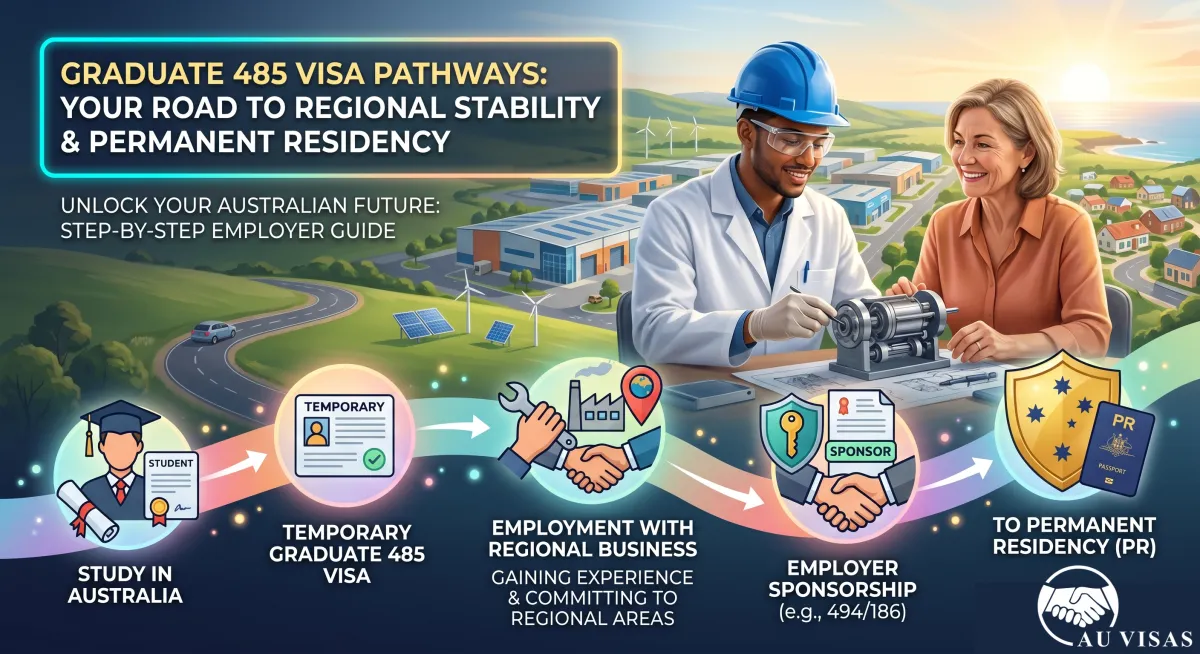
Graduate Visa 485 to 482 and 494 Pathways Guide
If you have advertised a job recently, you have likely seen it.
A stack of applications. A few locals. A handful of overseas candidates. And then a group sitting quietly in the middle:
People already in Australia. Already trained. Ready to start.
Those are typically Graduate Visa 485 holders.
Most regional employers overlook them or misunderstand them.
That is a missed opportunity.
Because when you understand how the 485 works, it becomes one of the most practical, low-risk hiring pipelines available, especially outside the major cities.
This guide breaks it down properly, with the real-world details employers actually need.
What the 485 Visa Actually Is (And Why It Exists)
The Graduate Visa 485 is a temporary visa for international students who have completed study in Australia.
From the Government’s perspective, the goal is simple:
Allow skilled graduates to prove themselves
Let them gain real work experience
Filter who is genuinely employable
Feed strong candidates into skilled migration pathways
It is not a guarantee of permanent residency.
It is a trial window.
And for employers, it is effectively a pre-qualified talent pool.
The Two Types of 485 Visas (This Matters More Than You Think)
This is where many employers get caught out.
There are two main streams:
Graduate Work Stream (GW)
Typically around 18 months
Requires a skills assessment
Must align closely with a specific occupation
Post-Study Work Stream (PSW)
Bachelor degree: around 2 years
Masters: around 3 years
Doctorate: around 4 years
No skills assessment required at visa stage
Regional Advantage (Often Missed)
If the graduate studied and works in a regional area:
They may access an additional 1–2 years
In practice, this can mean 3–4 years total work rights
That is a major advantage.
City employers do not get this.
Regional employers do.
Age Profile (And Why It Helps Employers)
Most 485 visa holders are under 35.
This is not an accident.
It means you are typically hiring:
Early-career workers
Mobile and open to relocation
Less tied to a specific city
For regional businesses, that matters.
They have already moved once to study.
They are far more likely to move again for the right opportunity.
Work Rights and Hiring Flexibility
Most 485 holders have:
Full work rights
No employer restrictions
No sponsorship required to hire
This gives you something powerful:
You can hire first, decide later.
The "Try Before You Sponsor" Advantage
This is one of the biggest commercial advantages in the entire system.
You can:
Hire a 485 holder
Work with them for 6–12 months
Assess performance properly
Then decide on sponsorship
No offshore recruitment process gives you that level of certainty.
Pre-Graduation Hiring Strategy (Almost No One Uses This)
You do not have to wait until graduation.
International students can:
Work up to 48 hours per fortnight during study
Work unlimited hours during official breaks
This means you can:
Bring someone in casually during their final year
Train them in your systems
Transition them to full-time once the 485 is granted
Important note:
If they are doing productive work, they must be paid correctly under workplace laws. This is not optional.
This approach reduces hiring risk dramatically.
What Skills Are Actually Available?
This is where perception and reality often differ.
Trades and Technical
Welders and fabricators (in some pathways)
Mechanical and automotive technicians
Electrical support roles
Construction
Civil engineers
Quantity surveyors
Drafting and CAD roles
Hospitality
Chefs and cooks
Supervisory roles
IT and Business
Developers
Analysts
Accounting graduates
Important:
Not every graduate will suit every visa pathway.
Occupation lists, skills assessments, and role alignment matter.
This is one of the first things to check.
Why 485 Graduates Perform Well
From a business perspective:
They Are Already in Australia
No delays. No waiting.
They Are Highly Motivated
They are not just looking for a job.
They are looking for a future.
They Are Pre-Tested
You can see their performance before committing.
They Are Connected
They bring:
University cohort networks
Peer groups
Lecturer contacts & possibly ongoing access
Treat one well, and they often bring others.
The Transition: 485 to Sponsorship
At some point, the conversation shifts:
"Can we keep them?"
There are two main pathways for employers.
Pathway 1: Skills in Demand Visa (Previously 482)
The modern version of the 482 is the Skills in Demand visa.
For most regional employers, the relevant stream is:
Core Skills stream
Key considerations:
Role must align with an approved occupation
Salary must meet the required threshold (around $73,150, increasing to around $79,499 from July 2026)
Labour Market Testing is required first
English requirements may apply
Bridging Visa Advantage
If the application is lodged while the 485 is still valid:
The worker moves onto a Bridging Visa A
They usually continue working without interruption
This is a major advantage over offshore hires.
Pathway 2: The Regional Pathway (494 to 191)
This is the one many employers miss.
And for regional businesses, it is often the better fit.
Subclass 494 (Regional Employer Sponsored)
Designed specifically for regional areas
Employer-sponsored like the 482
Broader long-term workforce planning
Subclass 191 (Permanent Residency)
Available after 3 years working regionally
This creates a clear pathway:
Temporary work → Regional commitment → Permanent residency
For regional employers, this aligns directly with workforce stability.
How Long Does It Take?
Realistically:
SBS approval: weeks to a few months
Nomination and visa: Instant to several months depending on circumstances
Skills assessments (if required): can take 2–6 months
Key takeaway:
Start early.
Leaving this until the last 6 months of a 485 visa is risky.
What Does Sponsorship Actually Cost?
There are real costs involved.
Skilling Australians Fund (SAF) Levy
Small business (<$10M revenue): around $1,200 per year of visa
Paid upfront
Example:
A 2-year nomination = around $2,400 total
That is roughly $3.30 per day
Framed like that, for a skilled worker you have already tested, it is often very manageable.
Sponsor Obligations (Important)
When you sponsor someone, you must:
Keep proper records
Notify the Department of changes
Not recover sponsorship costs from the worker
Passing costs onto the worker is not allowed.
Penalties can be serious.
Pathway to Permanent Residency (How It Actually Works)
This is where employers get clarity.
482 / Skills in Demand
Can lead to permanent residency after a qualifying period
Typically involves staying with the same employer
494 Regional Pathway
3 years working regionally
Then eligible for permanent residency (Subclass 191)
This is not automatic.
But it is structured.
Common Risks Employers miss
Not checking which 485 stream the worker is on
Leaving sponsorship too late
Not planning for salary increases at sponsorship stage
Skills assessments taking longer than expected
Unexpected SAF levy costs
Designing a role too senior for a graduate
Final Thought
Most regional employers are competing for the same local workforce.
485 graduates are different.
They are:
Already here
Already trained
Already motivated
And importantly:
They are looking for someone to give them a shot.
If you have the structure to support them, they can become long-term, high-value members of your team.
Glossary of Key Terms
485 Visa
Temporary visa allowing graduates to work after study.
Skills in Demand Visa
Employer-sponsored visa replacing the 482 framework.
494 Visa
Regional employer-sponsored visa.
191 Visa
Permanent residency visa for regional workers.
SBS
Approval required to sponsor overseas workers.
LMT
Process of advertising roles locally before sponsorship.
SAF Levy
Government fee paid by employers when sponsoring workers.
Bridging Visa A
Temporary visa allowing continued work while another visa is processed.
Related Articles
Related Articles that you may enjoy
https://auvisas.au/post/becoming-a-business-sponsor
https://auvisas.au/post/common-visa-mistakes
https://auvisas.au/post/labour-market-testing
https://auvisas.au/post/costperday
Source: AU Visas Employer Guide Series
Mandatory Disclaimer
The content provided is for informational purposes only and does not constitute immigration or legal advice. It is subject to change. Consult a MARA-registered migration agent or lawyer for professional advice before making any application.
Contact AU Visas today for a professional opinion on your situation. https://auvisas.au/free-consult for business.


