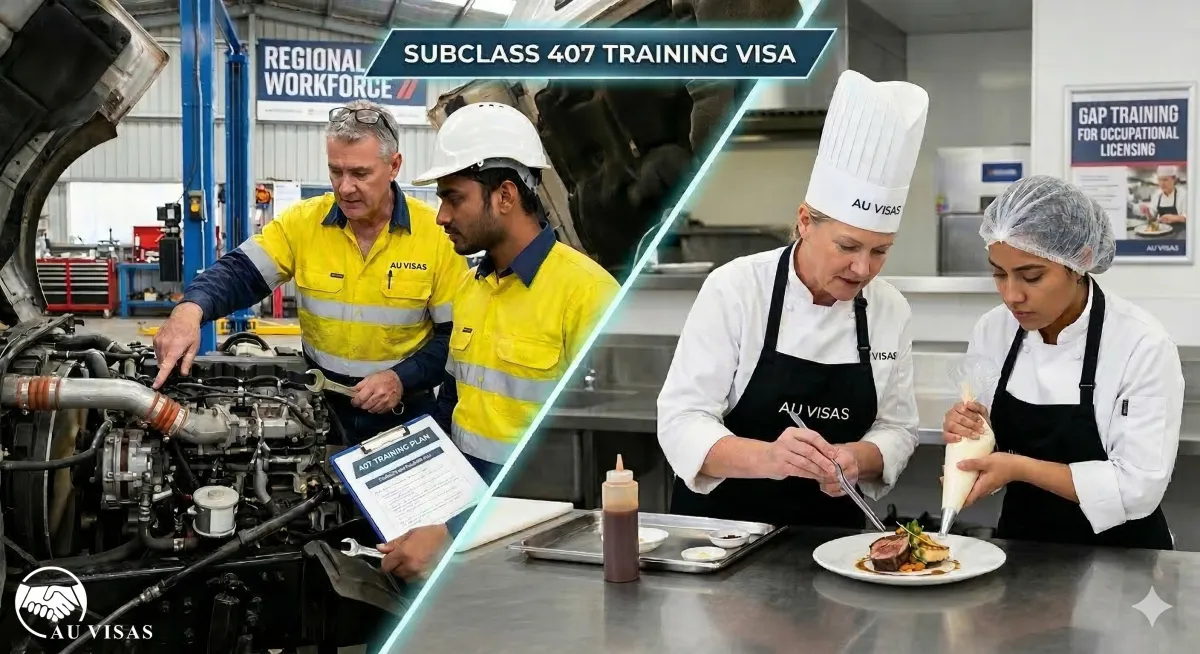
407 Training Visa for Employers
Regional business owners understand something that government paperwork often forgets:
Good workers must sometimes be developed, if they cannot be found.
A mechanic might have strong experience overseas but still need certifying to Australian workshop standards.
A chef might have solid culinary training but need time inside a professional Australian kitchen.
An electrician or plumber might have real experience but still need supervised experience aligned with local licensing expectations.
That is exactly the type of situation the Subclass 407 Training Visa was designed for.
The 407 is a structured workplace training visa. It allows a business to bring someone to Australia temporarily so they can develop occupational skills through supervised training in the workplace.
When used properly, the 407 can become a workforce development tool for regional employers. It provides time to train, observe and assess someone before deciding whether a longer-term sponsorship pathway makes sense.
But there is one important update employers should be aware of.
Important 2026 Regulatory Update
In March 2026, the Australian Government introduced the Migration Amendment (Training Visas – Sponsorship Requirements) Regulations 2026.
The change tightened the order of the application process.
Before 11 March 2026, sponsorship, nomination and visa applications were sometimes prepared together.
Under the new rules, the process is now sequential.
For a valid 407 visa application to be made:
The employer must already be approved as a Temporary Activities Sponsor
The training nomination must already be approved
Only then can the visa application be lodged
The Department introduced this reform after seeing a significant increase in onshore applications that were not aligned with genuine training programs.
For regional employers, the practical takeaway is simple:
The 407 visa now requires planning ahead.
It works best when used as a pipeline workforce strategy, not a last-minute staffing solution.
Quick Summary for Employers
The 407 visa works best when:
✔ The worker already has relevant experience
✔ The business can provide structured training
✔ The goal is skill development or licensing progression
✔ The employer wants time to train and assess the worker
Typical visa length:
Up to 2 years
Family members:
Usually allowed to accompany the trainee
Travel:
Generally allowed while the visa remains valid
Government visa application charge:
From approximately $430 for the main applicant
The Two 407 Training Streams Most Relevant to Employers
Although the visa technically includes three training types, two are most relevant for businesses.
1. Training Required for Registration
This stream allows workplace training where someone needs experience or supervised training to obtain:
professional registration
licensing
membership of an industry body
This is particularly relevant for occupations such as:
electricians
plumbers
air-conditioning and refrigeration mechanics
In these trades, overseas workers may have real skill but still need local exposure to Australian systems before they can progress further toward local licensing outcomes.
2. Occupational Training to Improve Skills
The second common stream is used where someone already has occupational grounding and needs additional structured workplace training.
To qualify for this stream, the nominee generally needs:
relevant qualifications or training
roughly 12 months of full-time experience in the occupation
This is where the visa becomes very useful for roles such as:
Motor Mechanic (General)
Diesel Motor Mechanic
Chef
These occupations appear in the legislative instrument used for the 407 visa.
For employers, this provides a structured environment to lift someone from “competent” to “Australian-ready”.
Realistic Scenarios for Regional Employers
Scenario 1: Motor Mechanic
A regional workshop finds a mechanic overseas with solid mechanical experience but limited exposure to Australian workshop systems.
Instead of expecting them to perform at full capacity immediately, the business builds a training program covering:
Australian workshop safety systems
diagnostic procedures
customer reporting standards
preventative maintenance routines
Over 18–24 months the mechanic becomes fully comfortable with the business’s systems.
The employer gains a real understanding of the worker’s capability before deciding whether longer-term sponsorship makes sense.
Scenario 2: Diesel Mechanic
Diesel mechanics are in strong demand across regional Australia, especially in transport, agriculture and heavy equipment servicing.
A regional employer identifies an overseas diesel technician with strong foundational skills but limited experience with Australian heavy vehicle servicing systems.
A structured training program might include:
diagnostic workflow
job documentation and tracking
preventative servicing programs
workshop safety procedures
This gives the employer time to develop and evaluate the worker within the real workplace environment.
Scenario 3: Chef
Regional hospitality businesses often struggle to recruit experienced chefs.
The 407 visa allows a restaurant or hospitality group to structure an on-the-job training program around:
commercial kitchen systems
food safety procedures
menu consistency and service flow
inventory and kitchen management
A training plan might run for around 18 months, giving the employer time to assess the candidate’s capability and fit with the kitchen team.
Scenario 4: Licensed Trades (Electricians, Plumbers, HVAC)
In some licensed trades the issue is not the worker’s ability, but alignment with Australian licensing systems.
An overseas electrician or plumber may have strong trade capability but still require supervised exposure to Australian work environments.
A training program may include:
Australian safety and compliance practices
testing procedures
documentation standards
supervised site work
This helps convert overseas experience into skills that operate effectively within Australian systems.
Strong Points of the 407 Visa
It supports workforce development
The visa recognises that many skills are developed through structured workplace training.
It gives employers time to assess a worker
Instead of committing to long-term sponsorship immediately, the employer can observe performance over time.
It works well for trades and technical roles
Many occupations require hands-on learning inside a real workplace.
It can support a longer workforce pipeline
In some situations the experience gained during a 407 visa can contribute toward eligibility for later skilled migration pathways if both employer and worker wish to continue.
Realistic Limitations
The 407 visa works best when the training purpose is genuine.
Key points employers should understand:
The training plan must be structured
The Department expects clear documentation showing what skills will be taught and how progress will be monitored.
The worker must already have experience
This visa is not designed for someone starting from zero.
Planning time is required
Because of the 2026 regulatory change, the sponsorship and nomination must be approved before the visa application can be lodged.
Wages and Workplace Laws
Although the visa is designed for training, Australian workplace laws still apply.
Employers must comply with:
applicable Award wages
national minimum wage requirements
superannuation obligations
The 407 visa works best when employers approach it as a training investment, not simply a wage strategy.
Typical Costs
Government charges can change, but employers generally encounter costs such as:
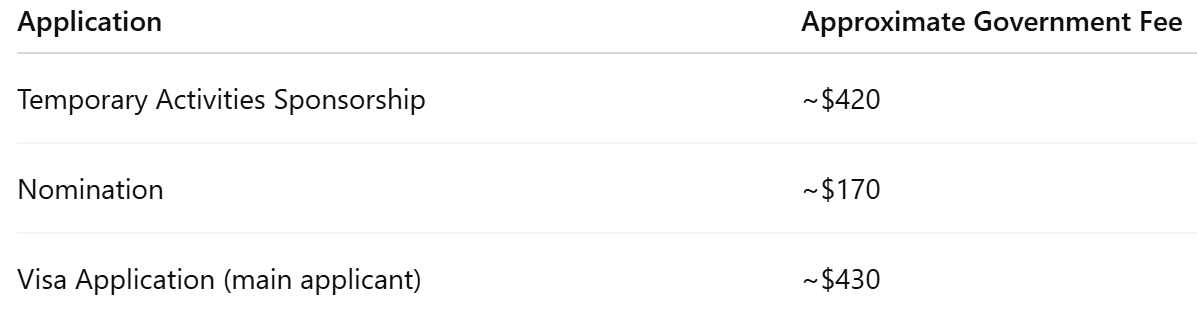
Additional costs may include:
preparing the training plan
internal supervision time
professional assistance if used.
Processing Timeframes
Visa processing times can vary depending on the complexity of the application and government workload.
Employers should generally allow:
several weeks to prepare documentation
several months for visa processing
The new sequential application process introduced in 2026 can also extend the practical timeline.
This is why the 407 works best when used as part of forward workforce planning.
Visa Conditions to Be Aware Of
Most 407 visas include Condition 8102, meaning the visa holder can only work in the approved training activity.
In some cases the visa may include Condition 8503 (No Further Stay), which can prevent applications for further visas while the person remains in Australia.
Employers should always review the visa grant letter carefully.
Can the 407 Lead to Permanent Residency?
The 407 visa itself does not provide a direct pathway to permanent residency.
However, the experience gained during the visa may help a worker become eligible for other migration pathways in the future.
For some regional employers, the visa becomes part of a broader workforce strategy:
training → experience → future sponsorship review.
Final Thoughts
The 407 Training Visa is often misunderstood.
It is not a “cheap labour” visa.
It is not a quick fix for a staff shortage.
But for regional businesses willing to train people properly, it can be a powerful workforce development tool.
It allows employers to:
bring in capable trainees
provide structured workplace learning
assess real-world performance
build a stronger workforce pipeline over time.
For occupations such as motor mechanics, diesel mechanics, chefs and licensed trades, this can be a very practical approach to developing skilled staff in regional Australia.
Glossary of Key Terms
Temporary Activities Sponsor
A business approved by the Department of Home Affairs to sponsor trainees under temporary activity visas.
Nomination
The application that outlines the training program and the occupation involved.
ANZSCO
Australia and New Zealand Standard Classification of Occupations used to define job roles.
Condition 8102
Visa condition limiting work to the approved training activity.
Condition 8503
“No Further Stay” condition that can restrict applying for additional visas while in Australia.
Related Articles
Related Articles that you may enjoy
https://auvisas.au/post/becoming-a-business-sponsor
https://auvisas.au/post/common-visa-mistakes
https://auvisas.au/post/labour-market-testing
https://auvisas.au/post/costperday
Source: AU Visas Employer Guide Blog Series
Mandatory Disclaimer
The content provided is for informational purposes only and does not constitute immigration or legal advice. It is subject to change. Consult a MARA-registered migration agent or lawyer for professional advice before making any application.
👉 Contact AU Visas today for a professional opinion on your situation. https://auvisas.au/free-consult for business.


